This week's Newspoll shows the ALP's lead go from 58-42 to 55-45.
Time for rejoicing in the Liberal Party? Time for panic in the Government ranks? Hardly.
Yes, the ALP's primary vote went down 5 points from 47% to 42%, but where did those votes go? Not to the Liberals or Nationals. The Opposition's primary vote only went up from 37% to 38%. Most of the leakage from the ALP went to the Greens (up from 9% to 11%) and to "others" (code for 'dunno') up from 7% to 9%.
So that gives the ALP a two party preferred lead of 55% to 45%. And just to remind everyone, at he 2007 election the 2 party preferred was 52.7% to 47.3%. So on the basis of this poll the ALP would increase its majority.
But let's look at how the leaders are going. Kevin Rudd's satisfaction rating has dropped from the absurd level of 66% to the still pretty bloody absurd 64%. His dis-satisfaction rating? All the way up up from 25% to 26%. In other words, people still like him. If they keep liking him like this the ALP will absolutely bolt in the next election.
What about the Member for Wentworth? Well he is still in negative territory - Satisfied 36% (down 1%), dis-satisfied 45% (down 1%).
On the Preferred PM question, Rudd dropped from 67% to 64%, but Turnbull stayed dormant on 19% (all the leakage went to "undecided).
This poll is actually worse for Turnbull than the last one. With the ALP well out in front no one in the Liberal Party would be bothering about changing leaders. But if (and it's a big bloody "if") the polls continue to move away from the ALP on the two party preferred, but Turnbull stays in negative satisfaction territory, well then he is dead.
Always remember, when the ALP kicked out Beazley for Rudd it was because they were ahead in the polls, but Beazley had a net satisfaction rating of around minus 30.
The big interest though is the Budget coming on May 12. Historically the Budget actually doesn't affect the polls all that much but the 1993 "horror budget" of Keating/Dawkins did result in a 10% fall in the ALP's primary vote. Hard to see that happening this time round though - afterall Keating could only ever dream of a satisfaction rating in the 60s.
Interestingly the poll also asked about the budget and future stimulus.
Not surprisingly people want infrastructure rather than a cash payout (though people always say such things in polls...) by a margin of 85% to 12%. To be honest though, I would be shocked if the Government did announce anymore cash payouts. (I'd also be disappointed).
With regards the future tax cuts, 44% say they should go ahead, 47% say they shouldn't - hardly the type of numbers that would encourage the Government to be bold on this issue (though I think they should be). As Lenore Taylor points out, the 1993 budget was the one where Keating reneged on the "L.A.W. tax cuts" and the ALP still is shaken by the reaction that one got.
That legacy, and Howard's "core" and "non-core" promises has meant Rudd has been at absolute pains to keep every election promise. This is a worthy goal. But to be honest, times have changed, and we must change with them.
Tuesday, May 5, 2009


Monday, May 4, 2009
The Logies. Sigh
I didn't watch the Logies last night, and so this morning I awoke to a terrible sight in the newspaper:
MOST OUTSTANDING SPORTS COVERAGE:
AFL Grand Final (Channel Seven)
Beijing Olympics (Channel Seven)
Beijing Paralympics (ABC1)
Supercheap Auto Bathurst 1000 (Channel Seven)
Tour De France (SBS)
Yes, the Olympics coverage was judged the Best Sports coverage of 2008. Not most popular - Best - as in this was decided by the industry panel.
Bizarre.
Here's what I wrote a month ago when the nominations came out:
I have only one thing to say though about the "outstanding" programs. We obviously do not have many good sports telecasts, because Seven has been nominated for its telecast of the Beijing Olympic Games. All I know is that if it gets an award for that travesty, I will personally post a slow motion montage of me vomiting in reaction with some Celine Dion music playing in the background. If not showing Steve Hooker winning Gold for the Pole Vault live is what now constitutes outstanding sport coverage then we might as well throw in the towel and admit defeat right now.
Well, I have to admit I'm going to break my promise. Some things just aren't meant to be seen. (Though somewhat coincidentally I did wake up this morning with a big of a stomach bug and did actually throw up - obviously my stomach could sense that the montage people were celebrating.)
So well done to the Australian film industry for rewarding mediocrity, and for choosing as Best Sports coverage the one nominee that was aimed at people who don't like sport.
MOST OUTSTANDING SPORTS COVERAGE:
AFL Grand Final (Channel Seven)
Beijing Olympics (Channel Seven)
Beijing Paralympics (ABC1)
Supercheap Auto Bathurst 1000 (Channel Seven)
Tour De France (SBS)
Yes, the Olympics coverage was judged the Best Sports coverage of 2008. Not most popular - Best - as in this was decided by the industry panel.
Bizarre.
Here's what I wrote a month ago when the nominations came out:
I have only one thing to say though about the "outstanding" programs. We obviously do not have many good sports telecasts, because Seven has been nominated for its telecast of the Beijing Olympic Games. All I know is that if it gets an award for that travesty, I will personally post a slow motion montage of me vomiting in reaction with some Celine Dion music playing in the background. If not showing Steve Hooker winning Gold for the Pole Vault live is what now constitutes outstanding sport coverage then we might as well throw in the towel and admit defeat right now.
Well, I have to admit I'm going to break my promise. Some things just aren't meant to be seen. (Though somewhat coincidentally I did wake up this morning with a big of a stomach bug and did actually throw up - obviously my stomach could sense that the montage people were celebrating.)
So well done to the Australian film industry for rewarding mediocrity, and for choosing as Best Sports coverage the one nominee that was aimed at people who don't like sport.
Round Six: Or Things are starting to get set.
OK, there’s 8 teams on three and three, but they are not all equal.
Here’s a big prediction - After six rounds we can say that Geelong and Saint Kilda will be top 4, and Carlton, Hawks, Port and Collingwood will make the finals. The Bulldogs most likely will. I don’t think either Melbourne, West Coast, Fremantle, Essendon, North Melbourne or Richmond can conceivably make the finals. This means the Crows, Brisbane and Sydney are fighting for the final spot in the finals.
![clip_image001[12]](https://blogger.googleusercontent.com/img/b/R29vZ2xl/AVvXsEgvH_1fwtpC5QZuMJGIKTppew9FGWaqimxkaeJBmY5t3vOm83JgXb31fV8rl0mnBZ8WKOZuhiY-Hz4wwh9Ue_mcWLBjQxPZP7yA20YxQTzdaOpGyPBFfSOaWvYnpnwWlCz5fTvQvZl8-G-t/s1600-h/clip_image001122.gif "clip_image001[12]")
![clip_image001[8]](https://blogger.googleusercontent.com/img/b/R29vZ2xl/AVvXsEi6PZxNDJmt1fEjzqFllNFv9UKtgvJubPLnYbOv6tj6_0-L_-4RlBvX4LEHlZSytgarMx3ETPa2ufDbim53d28Vj4r05nykOgQG-JpPp5qsOKOHTT_bs_fn7_ruqMOj4PRKF8vjp-bu6WR6/s1600-h/clip_image00182.gif "clip_image001[8]")

![clip_image001[24]](https://blogger.googleusercontent.com/img/b/R29vZ2xl/AVvXsEgaoK1BE0ekYhOm1G2xBGGKG_h2xZJh2Mi6B73nvdCURb5SsAHH0rGpUiNeeT8XQbQqwqjuIcQhpxx8K6_DGLH8s0VE0l8_XcISj0KRTTYu-wcpcoSYlmiBk3Vf7mIZgDB6HYiyTDL2148T/s1600-h/clip_image001242.gif "clip_image001[24]")
![clip_image001[16]](https://blogger.googleusercontent.com/img/b/R29vZ2xl/AVvXsEg7ThLOYkMtk3qLAzpGqmdqSgpGSTsVL2LVj8AJFyk7H8_IIoMjMyarf1k9RLmPWuijHybFHVG3DaNb77QcXYr5BxE8O_aaOFo5d6xr_Zv2bAfLePRtfu23er1YWlAxYPmCFYIyYX99DYZl/s1600-h/clip_image001162.gif "clip_image001[16]")
![clip_image001[20]](https://blogger.googleusercontent.com/img/b/R29vZ2xl/AVvXsEiDDJpX-jINnjNh2NrZohDRJ0vOknqrybZVTNNIMPpzGWjPmyhefOa1s9IlLxWHJaUi15G3FOGRyQVQKK_8VHhKepceqso3SLvAo-GtiuR1vrPCzGy5pTypzecP-g0uvaEOJM77Lo-S08kb/s1600-h/clip_image001202.gif "clip_image001[20]")
![clip_image001[14]](https://blogger.googleusercontent.com/img/b/R29vZ2xl/AVvXsEi2I3hlIODdvJicO67QoInzlyM0xlpLuC6lD7r3T2aW0epOLuxnPPALpkh5yK-UDS3OJLNNR8mkUheytURLL78wn3LSNBA9fwbvWul7PLaW788Yb2mDAtFdrV7V0JqDJrqpDbrB0G0jaYJw/s1600-h/clip_image001142.gif "clip_image001[14]")
![clip_image001[22]](https://blogger.googleusercontent.com/img/b/R29vZ2xl/AVvXsEgZa-vC7H7FU_jtEvKgMD5ZcC5kpk1xvjw2IcYm9HVzHPisnUTCRB0BI-Sxf6KFslvwMsjsmOGNVfG_PSZW-BZoL10byRz96siH8StHq5NJxRtRWg7FJNUoFpkh-jx-2qrtAJbOW75iZFq3/s1600-h/clip_image001222.gif "clip_image001[22]")
![clip_image001[4]](https://blogger.googleusercontent.com/img/b/R29vZ2xl/AVvXsEgGQmanoMM7PNDfI7jfQmU9pImgRYM1ZFCG1gGfJzXj_42n5RNvh31mO5Cy0sTZ0r37ZrSjYnSovVDPERnJL4yFqsqT4joUVuQ4IXA38BnVKr0gepgmuujPlrPF9LPzuEvmbJZmdv_vYGCl/s1600-h/clip_image00142.gif "clip_image001[4]")
![clip_image001[6]](https://blogger.googleusercontent.com/img/b/R29vZ2xl/AVvXsEgLegEbyg9imkU-LfHB67YnpE3byAjln0s1QHc-1E15FwCoFI_rkqH4uxVc3cpQmF4NjimFd9myRkuNranNfHXIIXKgJY7rErYF5RdQg85MvoZR790TXYr9JkpwHdOIGS34udrvqMp0Rop8/s1600-h/clip_image00162.gif "clip_image001[6]")
![clip_image001[18]](https://blogger.googleusercontent.com/img/b/R29vZ2xl/AVvXsEgzV5TzPXXl3xClBvSreXmfyAhFjMlyRtc2YvO_cjAkGRb3UTXeyz-pesC6ODRLg_idhRC4W6diSjCYuTN9LBbCbcXmZ_lD9SihFUCbW2tDYZGNu71qhb29IEJTC2TUrJmXfpDDZtX36DgL/s1600-h/clip_image001182.gif "clip_image001[18]")
![clip_image001[30]](https://blogger.googleusercontent.com/img/b/R29vZ2xl/AVvXsEgesXAPhTdrO54bMAYYN5fuu9MwlUj7xlOoOLJ1C0pDU7g4PkFjuOzIm4gIYB_8PqfQhFsltKWOqN2m4Ph4wQKfjhnxSSMUzWK3xougfUbhBE6DPFaPyLCdimr8jYA6j-cSEPlRYgNigPxw/s1600-h/clip_image001302.gif "clip_image001[30]")

![clip_image001[10]](https://blogger.googleusercontent.com/img/b/R29vZ2xl/AVvXsEhtcvlnri8xc7FKW2UIh1shPc_Rox5daHXxsoUHB1BajsFFkBAUbiqg2fZh8HrNzRFRD4MKBLrqtJ_5ZcybLXRleGqbgSNh0_-zp_Ro-kiqQT06jG8obdzGJon47QUwYBA0VLZ7XOzDedNP/s1600-h/clip_image001102.gif "clip_image001[10]")
![clip_image001[28]](https://blogger.googleusercontent.com/img/b/R29vZ2xl/AVvXsEhbQ2LwdODOQ_yHWjcPvvyUYL3iwaqdqF_ZpLlTiQBV4kBFCEhskB2-aVIrNIwLLrD6wmGoM7o5KRz0nyv6QMZMJleWfv77E2bL9LFIswjQ32IyfR4GpXfeKrtTo4WsdvfcD435s6c1dzZx/s1600-h/clip_image001282.gif "clip_image001[28]")
![clip_image001[26]](https://blogger.googleusercontent.com/img/b/R29vZ2xl/AVvXsEi2UHSab4vfNyRhbolYLtNab6BuNCX-6aK970AYxVWAl7oL8sZiVOGa2Hpx_HSVey3Jf-SyC8R9xEi0XJ46Ky21SQkdIgVNXiOUxBivW8usB5K7-cBIEd4hqpo9Z33tgkzyncnMa4AlwEDF/s1600-h/clip_image001262.gif "clip_image001[26]")

Sunday, May 3, 2009
How else can you judge a book?
There’s no doubting that all intelligent book buyers care first and foremost about the cover.
I own over 500 books, and not one of them did I buy without considering the cover. No matter how good the writing, if the cover is bad, I’ll wait. I waited about 10 years before buying The Grapes of Wrath purely because I didn’t like the cover.
 Yes it is dopey, but it can’t be denied – and the publishers know it is true as well because they spend so much effort on trying to get the cover right. Just ask Louis de Bernieres how important a good cover is.
So distinctive is the cover of Captain Corelli’s Mandolin by Australian artist Jeff Fisher that at the end of the film Notting Hill you can see from just a quick glimpse that it is the book Hugh Grant’s character is reading while sitting on a park bench with Julia Roberts. Apparently Fisher gets lots of requests for signed prints of the cover, and even de Bernieres acknowledged the cover “played a major part in speeding up the rate of my success”. Fisher got paid 600 Livre for it, the design company got the awards (and de Berniers the royalties).
My wife likes the book more than I do, but there’s no denying it’s a cracker of a cover.
Sometimes novels are put out in an array of covers to try and capture a certain section of the market; and it must work because I know there are some covers I ignore, and others I find irresistible.
Consider Jane Austen’s Emma. Here’s three different covers:

This one on the left screams “made for women who don’t like classics but who like chick-lit”. It came out as part of a series of generic covers of Austen’s novels; done no doubt in the hope that people will almost view them as sequels (in much the same way that say the second book by the author of The Devil Wears Prada has a similar style cover although the books have nothing in common but the author). I could never buy this book – mostly out of snobby condescension of the people to whom this cover is marketed.

The one on the right is the latest one to be done in the Penguin Classics series. You have to seriously wonder who was the blind git who chose this cover. If this is meant to be Emma Woodhouse, then I’m sorry, she doesn’t fit my picture of her.
This woman looks distinctly unappealing – why would anyone cross the room to talk to her? If I’m going to devote my time reading a novel for a month or so, I want to like the main character; and this woman is not someone I want to get to know. Yes Emma is an incredible snob; but this woman to me lacks any spark or joy that I love so much about Emma.
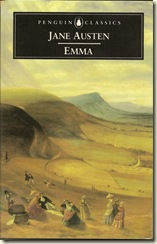
Here’s my copy.
It’s the previous edition of the Penguin Classics line.
It depicts a detail from some anonymous English artist’s painting “Picnicking at Devil’s Dyke, Newmarket”.
I don’t know about Devil’s Dyke, to me this scene depicts the pivotal Box Hill picnic from the novel.
It is a cover that feels like it has been chosen by someone who has actually read Austen, and knows her line about writing that “Three of four families in a country village is the very thing to work on”.
 Here we see the three or four families, on which she worked so fine a brush. I shall never buy another version.
Sometimes if a new edition comes out with a cover I like, I feel odd pangs while in the book store as I wish to buy it. The latest Penguin Classics version of Anna Karenina is a case in point. Here’s my current version on the right. It’s a good enough cover. The woman does look rather Anna Karenina like.
 But here is the latest version:
I want this copy! It makes my old copy look, well, old. The new one is vibrant, hints at the personality and the beauty of Anna.
I am trying to convince myself that I need this new version because it is also a new translation done by Larissa Volokhonsky and Richard Pevear.
The old copy doesn’t hold any sentimental value either, so all I have to do is convince myself I need a new copy of a book I already own (shouldn’t be too hard…).

Sometimes a cover doesn’t live up to what it suggests. Take the cover of Sue Woolfe’s Leaning Towards Infinity:
I have to admit I bought this novel basically because there was a photograph of a naked woman on the cover.
The blurb on the back about a housewife who happens to be a mathematical genius also intrigued me. The cover suggested something sensual and erotic – it’s a photograph from the 1920s, and the sepia tone seemed a nice contrast to the more harsh black and white covers around at the time (see The River Ophelia below).
But, I have to say I absolutely hated this novel. Hated it to the point of wishing the novel ill-health.
It seems like a book written for women who hate men. The prose was dull and lacking any poetic sense; the narrative structure, pointlessly contrived. It was a lesson for me that the cover cannot overcome the words inside. I sold it at a university second book sale that I used to be involved in running, and I felt guilty that I had allowed someone to buy it for a gold coin donation.
That said, it is a great cover.
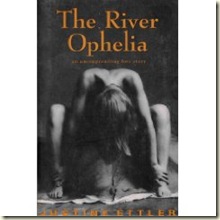
Another cover, that is much better than the novel inside is Justine Ettler’s The River Ophelia. Written in the mid-1990s and was marketed as one of the “dirty realism” novels of the time. I was thisclose to buying it due to the great cover – a lovely matte finish that was popular at the time. But the blurb about it being a raw confronting tale of modern romance put me off.
A few years later I met a woman who had read the novel. I asked her if it was any good. She said the cover was better. But then maybe I should have bought it – to buy a second hand copy of it now on Amazon will set you back US$29.
Other interesting covers are ones that I wish I owned, but sadly, by the time I got around to buying the book a new edition had came out.
 On this score is an early version of Umberto Eco’s The Name of the Rose:

The calligraphy and the look of a faded manuscript perfectly captures the sense and meaning of the novel. It doesn’t even matter that the whole left side of the cover contains quotes from reviewers.
It sure beats the heck out of the copy that I have – one of the generic Eco covers that came out in the 1990s (on the right). And while I don’t mind that cover (I did buy the book after all), I have a friend in South Australia who I see every Christmas time who has a copy of the older version on his bookshelf.
And every year a tiny part of me thinks about stealing the copy!
I keep looking for it in second hand stores, but have never come across a copy with this cover in good condition.
But enough of this prelude; here are my favourite covers from my bookshelf (in no particular order).

Ken Kesey, One Flew Over the Cuckoos Nest
As a general rule I hate movie tie-in covers. Rarely are they any good and if the movie is rather sub-standard, then you want to do all you can to avoid any connection (did anyone ever buy the movie tie-in cover of Bonfire of the Vanities?)
But this one is different. Jack Nicholson’s portrayal of McMurphy is indelibly linked with the book. And the photo of Nicholson perfectly captures the character. The orange background somehow works as well – and the colour scheme is almost unique to this book.
This was the version of the book that I first read in Year 12, and when I wanted to buy the novel a few years later I made sure I got this version.

David Guterson, Snow Falling on Cedars
You know this is a good cover, because every edition of the novel, besides the film tie-in, has used this photo. This was the first version. I came across it in a small bookstore in Melbourne one cold wintery night in June 1996. My wife and I had flown down to Melbourne for a holiday from Cairns where we lived at the time. Good bookstores were (and still are) pretty thin on the ground up north, and so we spent many an hour perusing the book stores in the Victorian capital.
A friend of mine from Canada had written to me (this was before email) recommending the book. When I saw the cover in that small bookstore, with the rain pelting down outside, I felt its matte finish and I knew this was a book for me. And it was – a wonderful novel.
The photograph by Stuart Simons captures the narrative’s mood precisely. And looking at the cover now, I realise I haven’t read the book for well over a decade, and I think it may be time to dive back into the mists of the Washington coast.

Nikos Kazantzakis, The Last Temptation
I picked this copy up in 1996 as well, and is one of the great faber and faber covers that features the black box in the top left corner. They no longer do covers this way, but for a long time there you could tell that faber was the publisher just by looking at the cover.
This novel is an amazing trip – hauntingly poetic; almost hypnotising. The cover of thorns set against the red background is actually a film tie-in, though you wouldn’t know it (aside from the diagonal slash down the bottom).
It’s a book where any depiction of a face would be immediately too limiting, too stereotypical, or too fake. You can’t put a picture of Jesus Christ on the cover of a novel and expect to be taken seriously. This picture focuses on the crucifixion and the last temptation that would occur there. The tangle of thorns goes well with the tangled narrative and visions within.

Nikolai Gogol, Dead Souls
Penguin Classics used to have great covers. As a rule I hate their new look – with the black band across the bottom, and the image/ painting occupying the top two-thirds. When I started reading literature, the Penguin Classics were in this form on the right – the image took up the whole front and the black box was at the top. I am nostalgic for it still, and mostly because (as with Emma above) they haven’t improved on the previous version.
When I saw this copy with the detail of Repin’s painting of “Procession in the Province of Kursk” I wanted to buy it without caring what the book was about.
I had vaguely heard of Gogol, but it was the cover that sold me. And good thing to, because this is a great work. Perhaps with Byron’s Don Juan, the great unfinished work of literature.

Roddy Doyle Paddy Clarke Ha Ha Ha
A brilliant example of how a photograph can capture a narrative perfectly. I have no idea if the young lad in this photograph by Derek Spiers is Irish or was taken at the time in which the novel is set. But it is impossible not to think that it is.
This kid is Paddy Clarke – testament of which is that they have kept using it for subsequent editions.
It reminds me for some reason of the Boy and War U2 covers, and perhaps that is why it had such an Irish feel to me.\
But the delight conveyed in the photograph disguises the absolute heartache inside.
A great cover – whoever picked the photograph deserves a cut of the royalties.

Rohinton Mistry, A Fine Balance
Another example of a great photograph. This time however it doesn’t aim to depict a character, more the feel of the novel. I don’t even know if it does it; but it conveys something – that sense that there is a world that we in the west don’t know about. Here’s a young Indian child balancing on the end of a pole that is in turn being held up by someone’s thumb.
Why is this happening? What is the child reaching for? Can we understand? It’s beguiling and yet also troubling – much like the novel.
A great cover – and one of the few that is mostly white.
The book though is another matter – pure brilliance, but easily the most suicide inducing narrative I’ve ever read. The characters are absolutely trashed by events and circumstances, and it ends on a note of pure despair. I read this one Christmas holidays. It didn’t quite fit in with the spirit of the season.

Fyodor Dostoyevsky, The Brother Karamazov
Another great Penguin Classics cover that has not been improved with the new. In fact the detail of the painting by Repin (that man again) of “The Rejected Confession”, is now being used by the cheap “Wordsworth Classics” edition of the novel.
But the main reason I love this cover is the little white spot you see to the right of the priest’s head. That spot is a bread crumb that has been stuck underneath Contact since 1994.
At the time my wife used to cover my books with contact (she is a school teacher after all). This particular book was a very precious purchase of mine at the time, and so when she covered the book and then noticed the crumb she was somewhat concerned about my reaction. I cannot actually recall what I said, but I believe I may have expressed some questions about her ability to do a simple remedial task (a remedial task it should be said that has long been beyond me). She no longer covers my books – quite rightly reasoning if I want them done, I can bloody well do it myself.
And so when I look at this cover, it is that crumb that brings a smile, as I recall how anal I used to get (and admittedly still am a bit) about books, and how understanding my wife is of my obsessions. I wouldn’t trade this copy for anything; the painting induced me to buy it, but the crumb makes it a treasured item of my life.
And that’s why covers are important. The novels I buy become part of my life, so I always make sure I’ll want to look at them for many years to come.
I own over 500 books, and not one of them did I buy without considering the cover. No matter how good the writing, if the cover is bad, I’ll wait. I waited about 10 years before buying The Grapes of Wrath purely because I didn’t like the cover.
 Yes it is dopey, but it can’t be denied – and the publishers know it is true as well because they spend so much effort on trying to get the cover right. Just ask Louis de Bernieres how important a good cover is.
 So distinctive is the cover of Captain Corelli’s Mandolin by Australian artist Jeff Fisher that at the end of the film Notting Hill you can see from just a quick glimpse that it is the book Hugh Grant’s character is reading while sitting on a park bench with Julia Roberts. Apparently Fisher gets lots of requests for signed prints of the cover, and even de Bernieres acknowledged the cover “played a major part in speeding up the rate of my success”. Fisher got paid 600 Livre for it, the design company got the awards (and de Berniers the royalties).
My wife likes the book more than I do, but there’s no denying it’s a cracker of a cover.
Sometimes novels are put out in an array of covers to try and capture a certain section of the market; and it must work because I know there are some covers I ignore, and others I find irresistible.
Consider Jane Austen’s Emma. Here’s three different covers:

This one on the left screams “made for women who don’t like classics but who like chick-lit”. It came out as part of a series of generic covers of Austen’s novels; done no doubt in the hope that people will almost view them as sequels (in much the same way that say the second book by the author of The Devil Wears Prada has a similar style cover although the books have nothing in common but the author). I could never buy this book – mostly out of snobby condescension of the people to whom this cover is marketed.

The one on the right is the latest one to be done in the Penguin Classics series. You have to seriously wonder who was the blind git who chose this cover. If this is meant to be Emma Woodhouse, then I’m sorry, she doesn’t fit my picture of her.
This woman looks distinctly unappealing – why would anyone cross the room to talk to her? If I’m going to devote my time reading a novel for a month or so, I want to like the main character; and this woman is not someone I want to get to know. Yes Emma is an incredible snob; but this woman to me lacks any spark or joy that I love so much about Emma.

Here’s my copy.
It’s the previous edition of the Penguin Classics line.
It depicts a detail from some anonymous English artist’s painting “Picnicking at Devil’s Dyke, Newmarket”.
I don’t know about Devil’s Dyke, to me this scene depicts the pivotal Box Hill picnic from the novel.
It is a cover that feels like it has been chosen by someone who has actually read Austen, and knows her line about writing that “Three of four families in a country village is the very thing to work on”.
 Here we see the three or four families, on which she worked so fine a brush. I shall never buy another version.
Sometimes if a new edition comes out with a cover I like, I feel odd pangs while in the book store as I wish to buy it. The latest Penguin Classics version of Anna Karenina is a case in point. Here’s my current version on the right. It’s a good enough cover. The woman does look rather Anna Karenina like.
 But here is the latest version:
I want this copy! It makes my old copy look, well, old. The new one is vibrant, hints at the personality and the beauty of Anna.
I am trying to convince myself that I need this new version because it is also a new translation done by Larissa Volokhonsky and Richard Pevear.
The old copy doesn’t hold any sentimental value either, so all I have to do is convince myself I need a new copy of a book I already own (shouldn’t be too hard…).

Sometimes a cover doesn’t live up to what it suggests. Take the cover of Sue Woolfe’s Leaning Towards Infinity:
I have to admit I bought this novel basically because there was a photograph of a naked woman on the cover.
The blurb on the back about a housewife who happens to be a mathematical genius also intrigued me. The cover suggested something sensual and erotic – it’s a photograph from the 1920s, and the sepia tone seemed a nice contrast to the more harsh black and white covers around at the time (see The River Ophelia below).
But, I have to say I absolutely hated this novel. Hated it to the point of wishing the novel ill-health.
It seems like a book written for women who hate men. The prose was dull and lacking any poetic sense; the narrative structure, pointlessly contrived. It was a lesson for me that the cover cannot overcome the words inside. I sold it at a university second book sale that I used to be involved in running, and I felt guilty that I had allowed someone to buy it for a gold coin donation.
That said, it is a great cover.

Another cover, that is much better than the novel inside is Justine Ettler’s The River Ophelia. Written in the mid-1990s and was marketed as one of the “dirty realism” novels of the time. I was thisclose to buying it due to the great cover – a lovely matte finish that was popular at the time. But the blurb about it being a raw confronting tale of modern romance put me off.
A few years later I met a woman who had read the novel. I asked her if it was any good. She said the cover was better. But then maybe I should have bought it – to buy a second hand copy of it now on Amazon will set you back US$29.
Other interesting covers are ones that I wish I owned, but sadly, by the time I got around to buying the book a new edition had came out.
 On this score is an early version of Umberto Eco’s The Name of the Rose:
The calligraphy and the look of a faded manuscript perfectly captures the sense and meaning of the novel. It doesn’t even matter that the whole left side of the cover contains quotes from reviewers.
It sure beats the heck out of the copy that I have – one of the generic Eco covers that came out in the 1990s (on the right). And while I don’t mind that cover (I did buy the book after all), I have a friend in South Australia who I see every Christmas time who has a copy of the older version on his bookshelf.
And every year a tiny part of me thinks about stealing the copy!
I keep looking for it in second hand stores, but have never come across a copy with this cover in good condition.
But enough of this prelude; here are my favourite covers from my bookshelf (in no particular order).

Ken Kesey, One Flew Over the Cuckoos Nest
As a general rule I hate movie tie-in covers. Rarely are they any good and if the movie is rather sub-standard, then you want to do all you can to avoid any connection (did anyone ever buy the movie tie-in cover of Bonfire of the Vanities?)
But this one is different. Jack Nicholson’s portrayal of McMurphy is indelibly linked with the book. And the photo of Nicholson perfectly captures the character. The orange background somehow works as well – and the colour scheme is almost unique to this book.
This was the version of the book that I first read in Year 12, and when I wanted to buy the novel a few years later I made sure I got this version.

David Guterson, Snow Falling on Cedars
You know this is a good cover, because every edition of the novel, besides the film tie-in, has used this photo. This was the first version. I came across it in a small bookstore in Melbourne one cold wintery night in June 1996. My wife and I had flown down to Melbourne for a holiday from Cairns where we lived at the time. Good bookstores were (and still are) pretty thin on the ground up north, and so we spent many an hour perusing the book stores in the Victorian capital.
A friend of mine from Canada had written to me (this was before email) recommending the book. When I saw the cover in that small bookstore, with the rain pelting down outside, I felt its matte finish and I knew this was a book for me. And it was – a wonderful novel.
The photograph by Stuart Simons captures the narrative’s mood precisely. And looking at the cover now, I realise I haven’t read the book for well over a decade, and I think it may be time to dive back into the mists of the Washington coast.

Nikos Kazantzakis, The Last Temptation
I picked this copy up in 1996 as well, and is one of the great faber and faber covers that features the black box in the top left corner. They no longer do covers this way, but for a long time there you could tell that faber was the publisher just by looking at the cover.
This novel is an amazing trip – hauntingly poetic; almost hypnotising. The cover of thorns set against the red background is actually a film tie-in, though you wouldn’t know it (aside from the diagonal slash down the bottom).
It’s a book where any depiction of a face would be immediately too limiting, too stereotypical, or too fake. You can’t put a picture of Jesus Christ on the cover of a novel and expect to be taken seriously. This picture focuses on the crucifixion and the last temptation that would occur there. The tangle of thorns goes well with the tangled narrative and visions within.

Nikolai Gogol, Dead Souls
Penguin Classics used to have great covers. As a rule I hate their new look – with the black band across the bottom, and the image/ painting occupying the top two-thirds. When I started reading literature, the Penguin Classics were in this form on the right – the image took up the whole front and the black box was at the top. I am nostalgic for it still, and mostly because (as with Emma above) they haven’t improved on the previous version.
When I saw this copy with the detail of Repin’s painting of “Procession in the Province of Kursk” I wanted to buy it without caring what the book was about.
I had vaguely heard of Gogol, but it was the cover that sold me. And good thing to, because this is a great work. Perhaps with Byron’s Don Juan, the great unfinished work of literature.

Roddy Doyle Paddy Clarke Ha Ha Ha
A brilliant example of how a photograph can capture a narrative perfectly. I have no idea if the young lad in this photograph by Derek Spiers is Irish or was taken at the time in which the novel is set. But it is impossible not to think that it is.
This kid is Paddy Clarke – testament of which is that they have kept using it for subsequent editions.
It reminds me for some reason of the Boy and War U2 covers, and perhaps that is why it had such an Irish feel to me.\
But the delight conveyed in the photograph disguises the absolute heartache inside.
A great cover – whoever picked the photograph deserves a cut of the royalties.

Rohinton Mistry, A Fine Balance
Another example of a great photograph. This time however it doesn’t aim to depict a character, more the feel of the novel. I don’t even know if it does it; but it conveys something – that sense that there is a world that we in the west don’t know about. Here’s a young Indian child balancing on the end of a pole that is in turn being held up by someone’s thumb.
Why is this happening? What is the child reaching for? Can we understand? It’s beguiling and yet also troubling – much like the novel.
A great cover – and one of the few that is mostly white.
The book though is another matter – pure brilliance, but easily the most suicide inducing narrative I’ve ever read. The characters are absolutely trashed by events and circumstances, and it ends on a note of pure despair. I read this one Christmas holidays. It didn’t quite fit in with the spirit of the season.

Fyodor Dostoyevsky, The Brother Karamazov
Another great Penguin Classics cover that has not been improved with the new. In fact the detail of the painting by Repin (that man again) of “The Rejected Confession”, is now being used by the cheap “Wordsworth Classics” edition of the novel.
But the main reason I love this cover is the little white spot you see to the right of the priest’s head. That spot is a bread crumb that has been stuck underneath Contact since 1994.
At the time my wife used to cover my books with contact (she is a school teacher after all). This particular book was a very precious purchase of mine at the time, and so when she covered the book and then noticed the crumb she was somewhat concerned about my reaction. I cannot actually recall what I said, but I believe I may have expressed some questions about her ability to do a simple remedial task (a remedial task it should be said that has long been beyond me). She no longer covers my books – quite rightly reasoning if I want them done, I can bloody well do it myself.
And so when I look at this cover, it is that crumb that brings a smile, as I recall how anal I used to get (and admittedly still am a bit) about books, and how understanding my wife is of my obsessions. I wouldn’t trade this copy for anything; the painting induced me to buy it, but the crumb makes it a treasured item of my life.
And that’s why covers are important. The novels I buy become part of my life, so I always make sure I’ll want to look at them for many years to come.
Thursday, April 30, 2009
Oscar is always wrong (except when it's right) Part VI: 1998
1998
1998 was a big year for the Oscars. It pitted Spielberg, going all out to win Best Picture for his WWII flick Saving Private Ryan, against the Mirimax machine trying to sneak away with the major prize for Shakespeare in Love. Added into the mix was the first film for 20 years by America auteur Terrence Malik with his take on WWII with The Thin Red Line, also the was the funny holocaust movie Life is Beautiful, the prescient The Truman Show and the history of Elizabeth.
It was a good year for films, but mostly a bad year for the Oscars.
Best Picture: Shakespeare in Love
Nominees: Saving Private Ryan, The Thin Red Line, Life is Beautiful, Elizabeth
Shakespeare in Love gets a pretty bum rap nowadays. Mostly because of the view that Mirimax stole the Oscar from Saving Private Ryan. To which I say, bullshit. Saving Private Ryan is the most over-rated piece of crap ever committed to celluloid. The film purports to treat war realistically, and yet the whole thing is a crock.
Apparently told by flashback, it is only at the end we discover we have been viewing the film through the eyes of Private Ryan. Which is ok, except Ryan doesn't come on the scene until two thirds of the way through the damn film, so God knows how he knew about the deaths of all those people on Omoha beach when he was a paratrooper. If you're going to tell a story it has to at least make logically sense.
It was also supposed to show how random death in war is, and yet in the end Captain Tom Hanks gets killed by the same German soldier who not an hour earlier in the film he had let go out of an act of kindness. Yep just like in the real war.
Plus every solider in the platoon looks to have been picked to ensure every single ethnic group (apart from blacks) is represented. Just like in real life.
Yeah the first half hour landing on Normandy is amazing; but that isn't the whole film. And the greatness of that 30 minutes is more than cancelled out by the last hour.
I hate the film because it lies to us. It told us (and remember the ad campaign) that this is the real thing - you were almost recommended to seek a doctor's certificate before watching the film. And then you find out its just the same old Hollywood horseshit. Screenwriter William Goldman called this film for the crock it was when he was making his choices for the Oscars of that year. I agree with him all the way.
Into the same basket of vomit, you can put Life is Beautiful. Manipulative and stupid - a heartwarming comedy movie about the holocaust? Give me a break.
Elizabeth? Excellent acting, but the history of the film is pretty bad, and while I don't mind a few liberties taken, it took too many for mine.
None of those three would even get nominated in my world.
The Thin Red Line? There's lots I love about the film - it is poetic, beautifully shot and some of the battle scenes are as gripping as any on film. But geez, would it hurt to have a narrative? And what the hell is George Clooney doing appearing only in the last minute? I would love to see the film with all the stuff that was left on the cutting room floor. It is the epitome of a flawed masterpiece.
If it had a more coherent narrative (and having read the book, I can tell you it is an incredibally loose adaptation) and less a sense that Malik wanted it to go for another hour I would be tempted to give it the Oscar. But as it stands I can't give it the award (even though it has a great score by Hans Zimmer).
This made-for-youtube trailer highlights a lot of what was great about it:
The big film missing from the nominations list is The Truman Show. I love this film and it is my runner up for Best Picture. The main reason for its brilliance is Peter Weir. He is one of the few great artists of the film world going around. In the mid 1990s, film magazine Movieline did a list of things Hollywood should do. One of them was "let Peter Weir do whatever he wants". This was the film that he wanted to do and it is brilliantly done.
The premise is excellent, the acting by all is top drawer - Jim Carrey showed he could act (much as Robin Williams did in Weir's earlier film Dead Poets Society), and it has a great score by Burkhard Dallwitz (wuth a big assist from Philip Glass). I'll write more about this film next week.
Two other less critically acclaimed films would make my list of nominees for that year. The first is the great comedy There's Something About Mary. In a time where the screens are filled with gross-out comedies like Superbad and Knocked Up (God I hated that film), it's easy to forget just how sweet this, the grandfather of all gross out comedies, was - and also just how damn funny. I had put off seeing this film because everyone I knew told me that it was the funniest thing they had ever seen. I was sure it could not possibly be, but decided to go along and give it a go. Well damn it contained more "I nearly wet myself laughing" moments than I had experienced for many a long day.
There was also the genius of having Jonathon Richman as the troubadour popping up after every act to provide a Greek chorus style commentary. And seriously how good was Cameron Diaz in this? Obviously there wasn't a lot of acting required, but there aren't many actresses who can do a scene with semen hair gel and still come across as the hottest girl you've ever met. Easily her best role (which admittedly doesn't say a real lot).
Sure it's not "Oscar material", but heck it was funny, it was popular, and it has been more influential than any of the other films nominated that year.
My other nominated film would be my equal favourite film of the year - and the one I've probably seen the most thanks to Channel 10's love of repeats.
Stephen Soderbergh's Out of Sight was great film making, with a great cast and screenplay working perfectly in sync.
It's hard now to think that at the time JLo was just Jennifer Lopez, and could be considered an actress rather than a headline. She was perfectly cast in this film, and works brilliantly with Clooney.
The supporting cast is amazing - Dennis Farina, Ving Rhames, Albert Brooks, Don Cheadle, and the perfect Steve Zahn all work together in perfect sync.
But the real winner of the film is George Clooney. This was the film in which he worked out that he was a film star. Prior to this his film acting was lacking something - like he didn't know if he was up to carrying a film, or whether he should be back playing Dr Doug Ross. Here's the four films he did before this role - From Dusk Till Dawn, Batman and Robin, One Fine Day and The Peacemaker. Now I actually like The Peacemaker, but even there he still seems to be a TV star lost in celluloid. But here he commands the screen. It's little wonder he has returned to work with Soderbergh so often, because the guy obviously taught him how to act on the big screen.
After this film his next 4 leading roles were in Three Kings, O Brother Where Art Thou? The Perfect Storm and Ocean's 11. Think there were any doubts about whether he could carry a film after those?
It's a good film done brilliantly. Intelligent, adult and fun. Why shouldn't it be nominated for best picture? After all back in 1941 The Maltese Falcon was nominated - why do we need to be so snobby now? Just look at how Soderbergh shoots this love scene - it is top drawer film making:
But the winner? I'm staying with Shakespeare in Love. Another film with a great cast in which every actor seems to know that they're in something special and is determined not to stuff it up.
Sure Gwyneth is a weak link - but she certainly doesn't destroy the film. Joseph Fiennes for one brief moment acts as well as his older brother, Ben Affleck has fun with his role, Rupert Everitt is Kit Marlowe, Colin Firth is marvelously up himself, and Geoffrey Rush is just amazing. For something fun, watch this and Elizabeth back to back, and besides seeing that Cate Blanchette could act Gwyneth under the table, you'll also notice how brilliant is Rush - few others could play a bumbling fool and a Machiavellian politician so believably.
The film is a delight - yeah sure it plays pretty lose with the order and timing of Shakespeare's plays, but it matters not a jot because there is no attempt to pretend this is real - it is a beautiful romp.
Best of all, after seeing this film I want to read Shakespeare - the guy seems real. Before this, even though I loved reading Shakespeare, I always thought of him as the old guy you see in the only portrait of him. Here he is young and dashing. This film made Shakespeare as accessible as any of the modernised versions that get made.
It had also had great score and witty script. The biggest oddity of the film is that the director John Madden would go on to do so little.
But so what? This film is still great entertainment, and, for mine, it keeps the Best Picture Oscar. The first 10 minutes gives a great taste of the whole:
***
There's still a lot of work left to fix this year, so I'll have to split it into a couple parts. I'll get onto the actors and directors next week.
1998 was a big year for the Oscars. It pitted Spielberg, going all out to win Best Picture for his WWII flick Saving Private Ryan, against the Mirimax machine trying to sneak away with the major prize for Shakespeare in Love. Added into the mix was the first film for 20 years by America auteur Terrence Malik with his take on WWII with The Thin Red Line, also the was the funny holocaust movie Life is Beautiful, the prescient The Truman Show and the history of Elizabeth.
It was a good year for films, but mostly a bad year for the Oscars.
Best Picture: Shakespeare in Love
Nominees: Saving Private Ryan, The Thin Red Line, Life is Beautiful, Elizabeth
Shakespeare in Love gets a pretty bum rap nowadays. Mostly because of the view that Mirimax stole the Oscar from Saving Private Ryan. To which I say, bullshit. Saving Private Ryan is the most over-rated piece of crap ever committed to celluloid. The film purports to treat war realistically, and yet the whole thing is a crock.
Apparently told by flashback, it is only at the end we discover we have been viewing the film through the eyes of Private Ryan. Which is ok, except Ryan doesn't come on the scene until two thirds of the way through the damn film, so God knows how he knew about the deaths of all those people on Omoha beach when he was a paratrooper. If you're going to tell a story it has to at least make logically sense.
It was also supposed to show how random death in war is, and yet in the end Captain Tom Hanks gets killed by the same German soldier who not an hour earlier in the film he had let go out of an act of kindness. Yep just like in the real war.
Plus every solider in the platoon looks to have been picked to ensure every single ethnic group (apart from blacks) is represented. Just like in real life.
Yeah the first half hour landing on Normandy is amazing; but that isn't the whole film. And the greatness of that 30 minutes is more than cancelled out by the last hour.
I hate the film because it lies to us. It told us (and remember the ad campaign) that this is the real thing - you were almost recommended to seek a doctor's certificate before watching the film. And then you find out its just the same old Hollywood horseshit. Screenwriter William Goldman called this film for the crock it was when he was making his choices for the Oscars of that year. I agree with him all the way.
Into the same basket of vomit, you can put Life is Beautiful. Manipulative and stupid - a heartwarming comedy movie about the holocaust? Give me a break.
Elizabeth? Excellent acting, but the history of the film is pretty bad, and while I don't mind a few liberties taken, it took too many for mine.
None of those three would even get nominated in my world.
The Thin Red Line? There's lots I love about the film - it is poetic, beautifully shot and some of the battle scenes are as gripping as any on film. But geez, would it hurt to have a narrative? And what the hell is George Clooney doing appearing only in the last minute? I would love to see the film with all the stuff that was left on the cutting room floor. It is the epitome of a flawed masterpiece.
If it had a more coherent narrative (and having read the book, I can tell you it is an incredibally loose adaptation) and less a sense that Malik wanted it to go for another hour I would be tempted to give it the Oscar. But as it stands I can't give it the award (even though it has a great score by Hans Zimmer).
This made-for-youtube trailer highlights a lot of what was great about it:
The big film missing from the nominations list is The Truman Show. I love this film and it is my runner up for Best Picture. The main reason for its brilliance is Peter Weir. He is one of the few great artists of the film world going around. In the mid 1990s, film magazine Movieline did a list of things Hollywood should do. One of them was "let Peter Weir do whatever he wants". This was the film that he wanted to do and it is brilliantly done.
The premise is excellent, the acting by all is top drawer - Jim Carrey showed he could act (much as Robin Williams did in Weir's earlier film Dead Poets Society), and it has a great score by Burkhard Dallwitz (wuth a big assist from Philip Glass). I'll write more about this film next week.
Two other less critically acclaimed films would make my list of nominees for that year. The first is the great comedy There's Something About Mary. In a time where the screens are filled with gross-out comedies like Superbad and Knocked Up (God I hated that film), it's easy to forget just how sweet this, the grandfather of all gross out comedies, was - and also just how damn funny. I had put off seeing this film because everyone I knew told me that it was the funniest thing they had ever seen. I was sure it could not possibly be, but decided to go along and give it a go. Well damn it contained more "I nearly wet myself laughing" moments than I had experienced for many a long day.
There was also the genius of having Jonathon Richman as the troubadour popping up after every act to provide a Greek chorus style commentary. And seriously how good was Cameron Diaz in this? Obviously there wasn't a lot of acting required, but there aren't many actresses who can do a scene with semen hair gel and still come across as the hottest girl you've ever met. Easily her best role (which admittedly doesn't say a real lot).
Sure it's not "Oscar material", but heck it was funny, it was popular, and it has been more influential than any of the other films nominated that year.
My other nominated film would be my equal favourite film of the year - and the one I've probably seen the most thanks to Channel 10's love of repeats.
Stephen Soderbergh's Out of Sight was great film making, with a great cast and screenplay working perfectly in sync.
It's hard now to think that at the time JLo was just Jennifer Lopez, and could be considered an actress rather than a headline. She was perfectly cast in this film, and works brilliantly with Clooney.
The supporting cast is amazing - Dennis Farina, Ving Rhames, Albert Brooks, Don Cheadle, and the perfect Steve Zahn all work together in perfect sync.
But the real winner of the film is George Clooney. This was the film in which he worked out that he was a film star. Prior to this his film acting was lacking something - like he didn't know if he was up to carrying a film, or whether he should be back playing Dr Doug Ross. Here's the four films he did before this role - From Dusk Till Dawn, Batman and Robin, One Fine Day and The Peacemaker. Now I actually like The Peacemaker, but even there he still seems to be a TV star lost in celluloid. But here he commands the screen. It's little wonder he has returned to work with Soderbergh so often, because the guy obviously taught him how to act on the big screen.
After this film his next 4 leading roles were in Three Kings, O Brother Where Art Thou? The Perfect Storm and Ocean's 11. Think there were any doubts about whether he could carry a film after those?
It's a good film done brilliantly. Intelligent, adult and fun. Why shouldn't it be nominated for best picture? After all back in 1941 The Maltese Falcon was nominated - why do we need to be so snobby now? Just look at how Soderbergh shoots this love scene - it is top drawer film making:
But the winner? I'm staying with Shakespeare in Love. Another film with a great cast in which every actor seems to know that they're in something special and is determined not to stuff it up.
Sure Gwyneth is a weak link - but she certainly doesn't destroy the film. Joseph Fiennes for one brief moment acts as well as his older brother, Ben Affleck has fun with his role, Rupert Everitt is Kit Marlowe, Colin Firth is marvelously up himself, and Geoffrey Rush is just amazing. For something fun, watch this and Elizabeth back to back, and besides seeing that Cate Blanchette could act Gwyneth under the table, you'll also notice how brilliant is Rush - few others could play a bumbling fool and a Machiavellian politician so believably.
The film is a delight - yeah sure it plays pretty lose with the order and timing of Shakespeare's plays, but it matters not a jot because there is no attempt to pretend this is real - it is a beautiful romp.
Best of all, after seeing this film I want to read Shakespeare - the guy seems real. Before this, even though I loved reading Shakespeare, I always thought of him as the old guy you see in the only portrait of him. Here he is young and dashing. This film made Shakespeare as accessible as any of the modernised versions that get made.
It had also had great score and witty script. The biggest oddity of the film is that the director John Madden would go on to do so little.
But so what? This film is still great entertainment, and, for mine, it keeps the Best Picture Oscar. The first 10 minutes gives a great taste of the whole:
***
There's still a lot of work left to fix this year, so I'll have to split it into a couple parts. I'll get onto the actors and directors next week.
Wednesday, April 29, 2009
A Song a Year: 1988, Run to Paradise
Sometimes a song that sticks in your head is not a song you particularly like. It can be an annoying ditty that worms its way into your skull despite your best efforts to delete it from your cerebrum. When I heard Britney Spears' "Piece of Me" I thought "My God that's a horrible song", and then proceeded to hear it every time I switched on FM radio and found myself actually knowing the damn lyrics.
Apparently the usual reason you find yourself with a song running through your head is because you have only heard a part of it, and your brain subconsciously keeps trying to complete it.
But when it comes to a song being associated with a year, you have to have heard that song completely, and much more than once. You still don't have to particularly like it.
And so it is with my 1988 song, The Choirboys "Run to Paradise".
1988 was when I did Year 12, and in the first week the entire class went on a camp to bond. This was about as dumb an idea as you could ever come up with given I went to school in a small country town where 97% of the class had been together since Grade 1.
We'd spent 11 years bonding, and had well and truly worked out who we did and did not wish to bond with. We knew who had gone out with who since Grade 5. We knew who had beaten up who in Grade 6. We knew who had got busted for smoking in Grade 7. We knew more about each other than we did about our families.
However, our teachers thought we really needed to get to know each other, and thus were forced to spend a week together doing "trusting games" (if memory serves me right a few people hit the floor instead of falling safely back into the arms of their team mates) and group activities that required completing a task without the use of one of our senses.
This served to ensure that when we got back to school the next week we would definitely continue to bond only with those people we had previously wanted to bond with, and were able to set our previous thoughts on other people in the most rock solid concrete. Nothing like waste of time to start Year 12, I guess - though it did help set the pattern for the rest of the year for me.
We also had to answer questionnaires that attempted to reveal things about us. Fortunately there was one new kid, so all 45 of us had an answer to the question "Who do you want to get to know better?". (And of course at least 42 of us didn't bother).
We were staying at a youth camp-site on the Murray River, with everyone sharing a cabin with 5 others. The cabin next to mine was full of guys who had ensured at least one had brought along his boom box. It was pretty cool - a double tape deck of the type that had a soft eject, it had high speed dubbing capacity, and a 5 band graphic equalizer. It also required about eight D size batteries than ran out pretty quickly if anyone dared use the fast forward button.
Unfortunately the most favoured song by the lads in that cabin was "Run to Paradise". And so like most 16 year olds, they played their favourite song over and over. And over. And over. And over. And over. And over. And over.
And over.
You see the owner had cleverly taped the song back to back on one whole side of a blank tape. So for 45 minutes without pause the Choirboys could be heard blaring out across the camp ground.
I liked the song for the first 5 or 6 listens.
By the end of the week I was ready to kill every person in the entire camping ground should the initial shout of Mark Gable singing "Baby!" be heard coming out of any speakers.
And thus despite the fact I liked other songs in 1988 - "Desire" by U2, "Got My Mind Set On You" by George Harrison, "Never Tear Us Apart" by INXS or the sadly underrated "She's Like the Wind" by Patrick Swayze (ahem...ummm err...ok people, move along nothing more to see here), when I think of 1988 it's the damn Choirboys, and even 21 years has done little to dull the memory.
Apparently the usual reason you find yourself with a song running through your head is because you have only heard a part of it, and your brain subconsciously keeps trying to complete it.
But when it comes to a song being associated with a year, you have to have heard that song completely, and much more than once. You still don't have to particularly like it.
And so it is with my 1988 song, The Choirboys "Run to Paradise".
1988 was when I did Year 12, and in the first week the entire class went on a camp to bond. This was about as dumb an idea as you could ever come up with given I went to school in a small country town where 97% of the class had been together since Grade 1.
We'd spent 11 years bonding, and had well and truly worked out who we did and did not wish to bond with. We knew who had gone out with who since Grade 5. We knew who had beaten up who in Grade 6. We knew who had got busted for smoking in Grade 7. We knew more about each other than we did about our families.
However, our teachers thought we really needed to get to know each other, and thus were forced to spend a week together doing "trusting games" (if memory serves me right a few people hit the floor instead of falling safely back into the arms of their team mates) and group activities that required completing a task without the use of one of our senses.
This served to ensure that when we got back to school the next week we would definitely continue to bond only with those people we had previously wanted to bond with, and were able to set our previous thoughts on other people in the most rock solid concrete. Nothing like waste of time to start Year 12, I guess - though it did help set the pattern for the rest of the year for me.
We also had to answer questionnaires that attempted to reveal things about us. Fortunately there was one new kid, so all 45 of us had an answer to the question "Who do you want to get to know better?". (And of course at least 42 of us didn't bother).
We were staying at a youth camp-site on the Murray River, with everyone sharing a cabin with 5 others. The cabin next to mine was full of guys who had ensured at least one had brought along his boom box. It was pretty cool - a double tape deck of the type that had a soft eject, it had high speed dubbing capacity, and a 5 band graphic equalizer. It also required about eight D size batteries than ran out pretty quickly if anyone dared use the fast forward button.
Unfortunately the most favoured song by the lads in that cabin was "Run to Paradise". And so like most 16 year olds, they played their favourite song over and over. And over. And over. And over. And over. And over. And over.
And over.
You see the owner had cleverly taped the song back to back on one whole side of a blank tape. So for 45 minutes without pause the Choirboys could be heard blaring out across the camp ground.
I liked the song for the first 5 or 6 listens.
By the end of the week I was ready to kill every person in the entire camping ground should the initial shout of Mark Gable singing "Baby!" be heard coming out of any speakers.
And thus despite the fact I liked other songs in 1988 - "Desire" by U2, "Got My Mind Set On You" by George Harrison, "Never Tear Us Apart" by INXS or the sadly underrated "She's Like the Wind" by Patrick Swayze (ahem...ummm err...ok people, move along nothing more to see here), when I think of 1988 it's the damn Choirboys, and even 21 years has done little to dull the memory.
Tuesday, April 28, 2009
The AFL Hall of Fame: Who Gets In (and Who Doesn't) Part Two
OK, Part One was easy, now it gets a bit tougher. First off let’s go with ones that probably should’ve been included in Part One.
The “Maybe I was Harsh” Category.
Dustin Fletcher (will be 300+ games, 2xAA, 2x Premiership)
Close your eyes. Your side is playing Essendon. Your full forward looks set to take a mark 25m out straight in front. If like you’re like me you’re also seeing a long gangly arm come though at the last minute to make a spoil. Fletcher was a great full back, who excelled at being bloody annoying – like all good full backs.
Simon Goodwin (243 Games, 4xAA, 2 x Premiership, 3x CC)
Really, Goodwin should be in. Hasn’t played as many games as Brent Harvey or Brad Johnson, but certainly as good.
Matthew Scarlet (211 Games, 4xAA, 1 x Premiership, 1xCC)
Fullback of the decade – give him another 3 seasons and he’ll be a motza for the Hall.
Warren Tredrea (250+ games, 500+ goals, 4xAA, 1x Premiership, 3xCC)
Tredrea has his knockers, but he has kicked more goals than Dermott Brereton, Alex Jesaulenko or Gary Lyon, and 4 all-Australians in row as centre-half forward can’t be ignored
The “Could Go Either way” Category
Tyson Edwards (will be 300+ Games, 2x Premiership)
Edwards has been Mr Dependable for the Crows, and is certainly one of those players most supporters would like in their side. But no all-Australian, no club champion medal, means he’ll have to get through on the basis of longevity and consistency. To be honest there’s a few others I’d vote for before him.
Michael O’Loughlin (possible 300 Games, 2xAA, 1xPremiership)
A player who could go mad and win a game, and then also go missing, But if he gets to 300 games, with the 2 all-Australians, you had to say he’s more likely than not to get in (I mean Dean Kemp is in the Hall...)
Adam Simpson (possible 300 Games, 1xAA, 2x Premiership)
Another player who if he gets in will be more on the basis of longevity than brilliance.
The “Will Need Kind Thoughts and Prayers to Get in” Category.
Scott Lucas (256 Games, 450+ goals, 2xCC, 1x Premiership)
The lack of an all-Australian selection hurts, and he looks like finishing up this year. 500 goals would put him in.
Brendan Fevola (2xAA, poss 700+ Goals)
Fev has only kicked 501 goals, but given his penchant for kicking goals he could get to 700. If he does it’d be hard to keep him out. (But that is a big “if”)
Barry Hall (242 games, 3xAA, 588 goals, 1xCC, 1x Premiership)
Hall has had a damn good career by any measure. Hall of Fame though? Maybe – might want to play another season at least. In roughly the same amount of games Saverio Rocca kicked 748 goals, so perhaps Barry is not quite up to the Hall level...
Now the fun part.
The “Wouldn’t get my Vote” Category
Shane O’Bree (220 games)
Sure he might get to 300 games, but he won’t get to the Hall.
Leo Barry (234 games, 2xAA)
Hmm, a close one. I’d leave him out – his mark in the 2005 Grand Final should be in the Hall, but not him.
Luke Power (222 games, 1xAA, 3xPremierships),
Lots of premierships, but he lacks the numbers of all-Australian selections of Voss, Black or Akermanis.
Anthony Rocca (412 goals, 1xColeman)
I’d put his older brother in the Hall well before I’d bother considering this Rocca.
And the rest of those I’d leave out:
Daniel Bradshaw (500+Goals, 2xPrem), Chad Cornes (2xAA, 200+ games) though if he plays 300+ I’ll think again, Darren Millburn (250+, 1xAA), Brendan Lade (2xAA), Darren Glass (2xAA) only 171 games, so there’s time for him to get there, Tom Harley (captain Prem, 1xAA), Joel Corey (181 games, 2xAA) – was drafted the same year as Pavlich and Jonathon Brown, and would need to get close to 300 games to be considered, Steven Johnson (1x Norm Smith, 2xAA), is still youngish so is a chance to add to his trophy cabinet – but winning a Norm Smith isn’t an automatic entry, Joel Bowden (258 games, 2xAA, 2xCC), he might be handicapped by playing for Richmond so maybe I’m being harsh, Kane Johnson (220 games, 2x prem, 1xCC) meh he should’ve stayed with the Crows.
The “Keep Going, You’re on the Way There” Category
Luke Hodge (137 games, 1x Norm Smith, 2xAA, 1xCC)
The trophy cabinet is looking good. Let’s hope for longevity.
Joel Selwood (50 games, 1xAA, Rising Star)
Number 7 in the 2006 Draft; bet at least 5 clubs are feeling stupid.
Bryce Gibbs (48 games)
Carlton however would still be pretty happy with Gibbs as their number 1 pick. He looks the goods for a 300 game career, and a full trophy cabinet.
Lance Franklin (86 games, 254 goals, 1xAA, 1xColeman, 1x Premiership, 1xCC)
After 86 games he’s already a superstar but the key will be how long he keeps it up for. Since 2007 he has averaged 3.88 goals a game, keep that up for 150 more games and he’s looking at 800+ goals (top 10 all-time).
Jarryd Roughead (88 games, 149 goals, 1x Premiership)
With Franklin could be one of the all-time great partnerships. Since 2007 he’s averaged 2.5 goals a game. Keep that up for another 150 games and he’ll have 500+ goals (more than Dermot Brereton).
Adam Cooney (115 games, 2008 Brownlow, 1xAA)
A Brownlow after so few games. The trick though is whether he is a Scott West or Shane Woewodin.
***
So now with all the current players out of the way (or at least on the ballot under my system) , that would leave the Hall of Fame "History Committee" to decide on all the pre-1990 players who should be on. Let me give them a few parochial hints:
Peter Carey (467 games !!!, 2xAA, 3xCC)
Seriously, how easy a decision is this??
Michael Aish (307 games, 2xAA, 1x Magery Medal, 4xCC)
One of the great "would've liked to see how well he would've played in the VFL" players.
Garry McIntosh (371 games, 2x Magery Medalist, 1x highest vote winner in Magery Medal, 5xCC)
I have absolutely no doubt he would have ruled the VFL, but nevertheless, he still should be in the Hall.
The “Maybe I was Harsh” Category.
Dustin Fletcher (will be 300+ games, 2xAA, 2x Premiership)
Close your eyes. Your side is playing Essendon. Your full forward looks set to take a mark 25m out straight in front. If like you’re like me you’re also seeing a long gangly arm come though at the last minute to make a spoil. Fletcher was a great full back, who excelled at being bloody annoying – like all good full backs.
Simon Goodwin (243 Games, 4xAA, 2 x Premiership, 3x CC)
Really, Goodwin should be in. Hasn’t played as many games as Brent Harvey or Brad Johnson, but certainly as good.
Matthew Scarlet (211 Games, 4xAA, 1 x Premiership, 1xCC)
Fullback of the decade – give him another 3 seasons and he’ll be a motza for the Hall.
Warren Tredrea (250+ games, 500+ goals, 4xAA, 1x Premiership, 3xCC)
Tredrea has his knockers, but he has kicked more goals than Dermott Brereton, Alex Jesaulenko or Gary Lyon, and 4 all-Australians in row as centre-half forward can’t be ignored
The “Could Go Either way” Category
Tyson Edwards (will be 300+ Games, 2x Premiership)
Edwards has been Mr Dependable for the Crows, and is certainly one of those players most supporters would like in their side. But no all-Australian, no club champion medal, means he’ll have to get through on the basis of longevity and consistency. To be honest there’s a few others I’d vote for before him.
Michael O’Loughlin (possible 300 Games, 2xAA, 1xPremiership)
A player who could go mad and win a game, and then also go missing, But if he gets to 300 games, with the 2 all-Australians, you had to say he’s more likely than not to get in (I mean Dean Kemp is in the Hall...)
Adam Simpson (possible 300 Games, 1xAA, 2x Premiership)
Another player who if he gets in will be more on the basis of longevity than brilliance.
The “Will Need Kind Thoughts and Prayers to Get in” Category.
Scott Lucas (256 Games, 450+ goals, 2xCC, 1x Premiership)
The lack of an all-Australian selection hurts, and he looks like finishing up this year. 500 goals would put him in.
Brendan Fevola (2xAA, poss 700+ Goals)
Fev has only kicked 501 goals, but given his penchant for kicking goals he could get to 700. If he does it’d be hard to keep him out. (But that is a big “if”)
Barry Hall (242 games, 3xAA, 588 goals, 1xCC, 1x Premiership)
Hall has had a damn good career by any measure. Hall of Fame though? Maybe – might want to play another season at least. In roughly the same amount of games Saverio Rocca kicked 748 goals, so perhaps Barry is not quite up to the Hall level...
Now the fun part.
The “Wouldn’t get my Vote” Category
Shane O’Bree (220 games)
Sure he might get to 300 games, but he won’t get to the Hall.
Leo Barry (234 games, 2xAA)
Hmm, a close one. I’d leave him out – his mark in the 2005 Grand Final should be in the Hall, but not him.
Luke Power (222 games, 1xAA, 3xPremierships),
Lots of premierships, but he lacks the numbers of all-Australian selections of Voss, Black or Akermanis.
Anthony Rocca (412 goals, 1xColeman)
I’d put his older brother in the Hall well before I’d bother considering this Rocca.
And the rest of those I’d leave out:
Daniel Bradshaw (500+Goals, 2xPrem), Chad Cornes (2xAA, 200+ games) though if he plays 300+ I’ll think again, Darren Millburn (250+, 1xAA), Brendan Lade (2xAA), Darren Glass (2xAA) only 171 games, so there’s time for him to get there, Tom Harley (captain Prem, 1xAA), Joel Corey (181 games, 2xAA) – was drafted the same year as Pavlich and Jonathon Brown, and would need to get close to 300 games to be considered, Steven Johnson (1x Norm Smith, 2xAA), is still youngish so is a chance to add to his trophy cabinet – but winning a Norm Smith isn’t an automatic entry, Joel Bowden (258 games, 2xAA, 2xCC), he might be handicapped by playing for Richmond so maybe I’m being harsh, Kane Johnson (220 games, 2x prem, 1xCC) meh he should’ve stayed with the Crows.
The “Keep Going, You’re on the Way There” Category
Luke Hodge (137 games, 1x Norm Smith, 2xAA, 1xCC)
The trophy cabinet is looking good. Let’s hope for longevity.
Joel Selwood (50 games, 1xAA, Rising Star)
Number 7 in the 2006 Draft; bet at least 5 clubs are feeling stupid.
Bryce Gibbs (48 games)
Carlton however would still be pretty happy with Gibbs as their number 1 pick. He looks the goods for a 300 game career, and a full trophy cabinet.
Lance Franklin (86 games, 254 goals, 1xAA, 1xColeman, 1x Premiership, 1xCC)
After 86 games he’s already a superstar but the key will be how long he keeps it up for. Since 2007 he has averaged 3.88 goals a game, keep that up for 150 more games and he’s looking at 800+ goals (top 10 all-time).
Jarryd Roughead (88 games, 149 goals, 1x Premiership)
With Franklin could be one of the all-time great partnerships. Since 2007 he’s averaged 2.5 goals a game. Keep that up for another 150 games and he’ll have 500+ goals (more than Dermot Brereton).
Adam Cooney (115 games, 2008 Brownlow, 1xAA)
A Brownlow after so few games. The trick though is whether he is a Scott West or Shane Woewodin.
***
So now with all the current players out of the way (or at least on the ballot under my system) , that would leave the Hall of Fame "History Committee" to decide on all the pre-1990 players who should be on. Let me give them a few parochial hints:
Peter Carey (467 games !!!, 2xAA, 3xCC)
Seriously, how easy a decision is this??
Michael Aish (307 games, 2xAA, 1x Magery Medal, 4xCC)
One of the great "would've liked to see how well he would've played in the VFL" players.
Garry McIntosh (371 games, 2x Magery Medalist, 1x highest vote winner in Magery Medal, 5xCC)
I have absolutely no doubt he would have ruled the VFL, but nevertheless, he still should be in the Hall.
Subscribe to:
Posts (Atom)