It goes without saying that tomorrow's Budget is a big one for the Rudd Government. So let's just just it anyway. It's a bloody big one for the Rudd Government.
It will define it.
I'm actually quite confident that it will be a good one - good in that it will be economically responsible and provide good stimulus through infrastructure, while beginning the long and horrible pruning job required to trim all the Howard-Costello hand-outs.
Crikey has a good list of all the Budget leaks.
The only one that really cuts me is the tinkering with the child care rebate. Mostly this is because it was not an inherited scheme, but something the ALP promised at the last election, and delivered last year.
Hopefully they just means test it, and have it done on a sliding scale and don't cut it off completely. Personally I think all Government handouts should be means tested - after all, income tax by virtue of the progressive taxation regime we have always had is means tested, so why not spending?
But herein lies the difficulty for Rudd and Swan and Co. To hand down an economically responsible budget they have to get rid of so much of the crud left over from the Howard years. All those masses of middle-income welfare, that now seems to be some sort of God given right.
Swan was right to blame Costello and Howard for the budget being so badly in deficit now - because it is NOT all the spending by the Government which has sent this budget into deficit. It is the collapse of around $100 billion in revenue. The reason revenue has collapsed so badly is that Howard handed out tax cuts as a matter of course during the boom years, thinking that Australia could cope by getting more of its taxes through Corporate Tax.
This policy worked really well and meant we stayed in surplus. There's was only one small caveat. It only worked so long as we continued to have a once in a generation mining boom.
The reason is that in a recession Corporate Taxes dive because profits dive. Income tax however doesn't go down by as much, because employment generally falls slightly, or flatlines (unemployment mostly increases because people coming into the workforce can't get a job). So reducing the dependency on income tax and increasing dependency on Corporate Tax makes for greater volatility of revenue.
So we're heading for a cut back of spending, and a big deficit.
Thankfully we've got Peter Costello to show us the way. Today, in responding to Swan pointing out Howard's and Costello's woeful record as economic managers. He said:
I think you’ve got to get a grip on the dimension of this,” Mr Costello told Melbourne radio today, on the eve of tomorrow's federal budget. “It is quit possible that Mr Swan has put this country into a debt that will not be repaid in our lifetimes. “Young people have got to know this; that they have been put into hock for a very long period of time by this government and they’ll be paying for it through their taxes probably for generations.”
Well I guess it was a bit much to hope for intelligence form Costello. Yes according to Peter, debt is always bad. I guess he'd prefer a depression, so long as there was no Government debt. Then again this a was guy who presided over a health system, the central tenant of which was to massively subsidise private health insurance to the detriment of public health, and whose idea of a good education policy was to increase subsidy of private schools to the detriment of public schools.
Here's some real intelligence Ross Gittens in the Sydney Morning Herald (and a bit of history):
When Howard was handing out tax cuts and cash bonuses with gay abandon, no one had a moment's doubt about their legitimacy. No one conducted long inquisitions into whether the money would be saved or spent, or even put through the pokies.
The fact that there's so much disapproval of cash bonuses now - but, no doubt, little disapproval of tax cuts - nicely illustrates a quirk of human nature that behavioural economists call "framing": people can react quite differently to essentially the same phenomenon depending on how it's framed or, as we'd say, packaged.
If it's news to you that the cash splash was invented by the sainted Howard, let me remind you. In the 2001 budget he and Peter Costello gave a one-off payment of $300 to everyone of age pension age, plus cash payments of $25,000 each to former prisoners of war of the Japanese, at a combined cost to the budget of more than $900 million.
In the 2004 budget Howard and Costello gave one-off payments of $600 per child to people receiving the family tax benefit, bonus payments of $600 or $1000 to carers, and cash payments of $3500 per place to providers of aged care accommodation, at a combined cost of $3 billion.
In the 2005 budget the $600 or $1000 bonus payments to carers were repeated at a cost of $320 million. The exercise was repeated again in the 2006 budget, by which time the cost had risen to $360 million. Seniors got a one-off utilities allowance costing $200 million.
In the 2007 budget the cash bonuses to carers were repeated, plus a one-off bonus to seniors of $500 each, at a combined cost of $1.7 billion. And that year's co-contribution for superannuation savers was retrospectively doubled, just the once, at a cost of $1.1 billion (with all of that, of course, guaranteed to be saved).
He then takes fools who think a Budget deficit and Government debt is bad by the scruff of the neck and gives them a few slaps:
Another difference is that whereas Howard's cash splashes were reducing a budget surplus, Rudd's are adding to a budget deficit. Howard could afford his, whereas Rudd can't afford his.
Think that's a good argument? If so, congratulations. Your understanding of the role of government budgets and the macro management of the economy is state-of-the-art circa 1936.
That is, it's pre the Keynesian revolution. Since Keynes, the great majority of economists have accepted that things such as stimulatory cash grants are unhelpful during times of boom (because they risk adding to inflation), but likely to be helpful during recessions (because, to some extent at least, they should add to private spending and hence diminish the rise in unemployment).
So, contrary to what a sort of Good Housekeeping approach to budgeting would suggest, good management involves governments being less generous during booms and more generous during recessions.
And here's something for you to ask next time your hear anyone (including Peter Costello or Malcolm Turnbull or Joe Hockey) say how bad this Budget deficit is, or how bad all this debt we'll have to pay off for "generations" - what should we cut, and what shouldn't we spend?
If their answer is "the cash splash", ask them why, seeing how IT WORKED. But then I guess you can say, well done you've now cut back around $20b of the deficit, but you have sat by while retail spending went down the toilet, and staff were laid off in their thousands. Congratulations.
Then ask what they were going to do about the other $80b that they need to cover due to decline in tax revenue.
Because here's the thing. You will not here Turnbull or Hockey or Costello refer to the $100b loss of tax revenue. All they will talk about is the "cash splash". I'm betting that according to them, every single cut in Government services (ie middle-income welfare) will be as a result of the 'cash splash'. You got $900, so that's why your private health rebate is now means tested. You got a cash splash, so that's why people won't be able to afford IVF treatment. etc etc.
It's all bull. But it will be effective.
And it's an easier sell than Rudd and Swan pointing out the decline in tax revenue due to a stuffed up tax revenue mix thanks to John Howard and Peter Costello. Regardless of the truth people will look at the Howard years and ignore the mining boom, and just think the surplus was proof the Libs knew what they were doing.
And with a newspoll set to come out next week, it's fair to say Rudd and Swan have some hard work in front of them - both economically and politically.
Monday, May 11, 2009


Thursday, May 7, 2009
The Economy: up is down?
In the last couple of days a few interesting economic figures have come out that suggest that running an economy is a complex thing.
The most recent figure announced was that unemployment had decreased from 5.7% to 5.4%. To say this is a shock is to put it rather mildly. Economists don't like being shocked - especially when they have all predicted that the complete opposite would happen.
So they shot the messenger. It was, they argued, all the fault of the Bureau of Statistics - the ABS had got it wrong. Now admittedly there is some weight to their argument. The ABS has decreased the sample size it uses to work out the unemployment figures (due to some rather dumb cutbacks by the Government). But even still, let's use some perspective. Peter Martin points out
"The ABS standard estimates say we can be 95 per cent confident the true change was somewhere between a drop of 33,300 and a gain of 87,900 people in jobs".
All statistics have a confidence value and a standard deviation. Maybe this figure is a statistical blip, maybe not. My gut feeling is that the reality is that there was not a rise in employment, but that due to the participation rate falling, the actual unemployed figure hasn't gone up either (as yet).
But for now these are the only figures we've got; so let's take them for what they say.
And what they say is good.
The other news out today was that the construction industry may be past its worst. The Australian Industry Group's Construction Index did fall in April, but the fall was slowing and suggested an upturn in the coming months. Especially given the schools funding programs about to kick into gear
Good news.
Yesterday there was also news that Australia had recorded its largest ever trade surplus - ie the amount of exports we're earning over the imports we're buying. Our coal and iron ore exports were holding up quite well. Imports dropped 10% which isn't actually good because it means we're not importing materials for construction or products for selling in shops (what we want is imports to grow, but not as much as our exports).
But still, the steadiness of our major exports is very good news.
Then there was the news on Tuesday that the RBA was not dropping interest rates. This is good because it suggests the RBA is not in panic mode, and can see a light at the end of the tunnel. In fact it said as much in the statement it put out:
The global economy contracted further during the first few months of this year. While the near-term outlook remains weak, there are further signs of stabilisation in several countries. The Chinese economy in particular has picked up speed in recent months and many commodity prices have firmed a little. The considerable economic policy stimulus in train in most countries should help contain the downturn and support an eventual recovery.
The final bit of good news was released yesterday and put to bed any doubts about whether or not the December stimulus package (the "cash splash") had worked.
Retail sales rose 2.2 per cent in seasonally adjusted terms to $19.3 billion in March, this was despite economists expecting it to rise only 05.%. (not a good month for economists' predictions). The reason why this is so good is that it comes before the second stimulus package was released in April, meaning that people were still spending money gained in December, or at the very least feeling confident enough to spend in anticipation of the April lot of $900s.
The ABS has a nice little graph that Peter Martin has used to show the impact of the stimulus:

Look at the trend line which cuts out at December last year. Do you think that trend line was about to zoom up? Nope, me neither.
Do you think it was probably going to at best flat line? Yep I agree, though a pessimist would look at what was happening in the rest or the world and think that trend line was about to go down - and sharply.
What the stimulus package did was increase retail sales. And that is exactly what it was put in place to do.
It worked! And it pumped money into the economy effectively.
So the next time a friend of yours tells you about how Rudd threw money at people and it all got saved you can call "bullshit" on them. It was not all saved - far from it. And neither was it all spent in one hit - you know that instant "sugar hit" that is soon forgotten. The spending continued above trend for December, January, February and March. (Which let's be honest is what you would expect - some people spent the money, others used it to pay off their credit card, and then a month or so later, because their credit card was clean, they went out and spent).
Now your friend can argue that the stimulus should not have been done with cash payouts, but then ask him if he was prepared to wear a flat line, or (more likely) a huge drop in retail sales, and all the job losses that go with it?
Your friend could argue that money should be spent on infrastructure - and he'd be right. Any more stimulus to come should be on mid to long term infrastructure. But the $10b spent on stimulus in December, you should remind your friend, was targeted to work in the short term. It was put in place to keep jobs now, and hopefully keep jobs in place till the mid-term infrastructure measures (you know all those buildings that are about to start happening in schools) kicked in.
And it worked. Without any shadow of a doubt, it worked.
Was it good policy? Well you can debate that all you want. But you can't argue that it didn't achieve what it was meant to achieve.
Now look, obviously it is not all plain sailing ahead. On Tuesday it was announced that car sales continue to fall, and job ads are still declining - meaning unemployment will rise.
But so far, the things the Government have done have worked the way they were supposed to. And that's good news as well.
The most recent figure announced was that unemployment had decreased from 5.7% to 5.4%. To say this is a shock is to put it rather mildly. Economists don't like being shocked - especially when they have all predicted that the complete opposite would happen.
So they shot the messenger. It was, they argued, all the fault of the Bureau of Statistics - the ABS had got it wrong. Now admittedly there is some weight to their argument. The ABS has decreased the sample size it uses to work out the unemployment figures (due to some rather dumb cutbacks by the Government). But even still, let's use some perspective. Peter Martin points out
"The ABS standard estimates say we can be 95 per cent confident the true change was somewhere between a drop of 33,300 and a gain of 87,900 people in jobs".
All statistics have a confidence value and a standard deviation. Maybe this figure is a statistical blip, maybe not. My gut feeling is that the reality is that there was not a rise in employment, but that due to the participation rate falling, the actual unemployed figure hasn't gone up either (as yet).
But for now these are the only figures we've got; so let's take them for what they say.
And what they say is good.
The other news out today was that the construction industry may be past its worst. The Australian Industry Group's Construction Index did fall in April, but the fall was slowing and suggested an upturn in the coming months. Especially given the schools funding programs about to kick into gear
Good news.
Yesterday there was also news that Australia had recorded its largest ever trade surplus - ie the amount of exports we're earning over the imports we're buying. Our coal and iron ore exports were holding up quite well. Imports dropped 10% which isn't actually good because it means we're not importing materials for construction or products for selling in shops (what we want is imports to grow, but not as much as our exports).
But still, the steadiness of our major exports is very good news.
Then there was the news on Tuesday that the RBA was not dropping interest rates. This is good because it suggests the RBA is not in panic mode, and can see a light at the end of the tunnel. In fact it said as much in the statement it put out:
The global economy contracted further during the first few months of this year. While the near-term outlook remains weak, there are further signs of stabilisation in several countries. The Chinese economy in particular has picked up speed in recent months and many commodity prices have firmed a little. The considerable economic policy stimulus in train in most countries should help contain the downturn and support an eventual recovery.
The final bit of good news was released yesterday and put to bed any doubts about whether or not the December stimulus package (the "cash splash") had worked.
Retail sales rose 2.2 per cent in seasonally adjusted terms to $19.3 billion in March, this was despite economists expecting it to rise only 05.%. (not a good month for economists' predictions). The reason why this is so good is that it comes before the second stimulus package was released in April, meaning that people were still spending money gained in December, or at the very least feeling confident enough to spend in anticipation of the April lot of $900s.
The ABS has a nice little graph that Peter Martin has used to show the impact of the stimulus:

Look at the trend line which cuts out at December last year. Do you think that trend line was about to zoom up? Nope, me neither.
Do you think it was probably going to at best flat line? Yep I agree, though a pessimist would look at what was happening in the rest or the world and think that trend line was about to go down - and sharply.
What the stimulus package did was increase retail sales. And that is exactly what it was put in place to do.
It worked! And it pumped money into the economy effectively.
So the next time a friend of yours tells you about how Rudd threw money at people and it all got saved you can call "bullshit" on them. It was not all saved - far from it. And neither was it all spent in one hit - you know that instant "sugar hit" that is soon forgotten. The spending continued above trend for December, January, February and March. (Which let's be honest is what you would expect - some people spent the money, others used it to pay off their credit card, and then a month or so later, because their credit card was clean, they went out and spent).
Now your friend can argue that the stimulus should not have been done with cash payouts, but then ask him if he was prepared to wear a flat line, or (more likely) a huge drop in retail sales, and all the job losses that go with it?
Your friend could argue that money should be spent on infrastructure - and he'd be right. Any more stimulus to come should be on mid to long term infrastructure. But the $10b spent on stimulus in December, you should remind your friend, was targeted to work in the short term. It was put in place to keep jobs now, and hopefully keep jobs in place till the mid-term infrastructure measures (you know all those buildings that are about to start happening in schools) kicked in.
And it worked. Without any shadow of a doubt, it worked.
Was it good policy? Well you can debate that all you want. But you can't argue that it didn't achieve what it was meant to achieve.
Now look, obviously it is not all plain sailing ahead. On Tuesday it was announced that car sales continue to fall, and job ads are still declining - meaning unemployment will rise.
But so far, the things the Government have done have worked the way they were supposed to. And that's good news as well.
Tuesday, May 5, 2009
The ETS Strategy
Yesterday Kevin Rudd came out and announced that the Government was watering down and delaying the introduction of its Emissions Trading System by one year - it would now start in 2011 instead of 2010.
This was a big back flip, as the Opposition had been arguing all along that this should be the starting date. So I guess Malcolm Turnbull wins and will now look like the sensible person balancing the environment and the economy. No doubt he will now be able to go to the next election looking like the real author of the ETS?
Err no.
That's because within about an hour of Rudd announcing he was doing what the Liberals had been arguing he should be doing, Turnbull came out and said this:
"On this basis what we've seen today we wouldn't support it."
Well done Malcolm, nothing like keeping up the nice trait of opposing everything the Government does. Mr Anti is at it again. Why not come out and say - "We're glad the Government has followed our suggestions, and I know look forward to working with the Government to ensure the best possible trading system comes into place in 2011"?
Such a move would render the Greens and Independents irrelevant, and give the Liberals a seat at the table, and make them look almost worthy of being called the alternative Government.
But no. He opposes. Even though the scheme has been watered down, is still a bit of a dog of a system, and given that no international agreement is likely, still doesn't really involve any increase in the target.
Why?
Well Bernard Keane of Crikey may have an idea:
The watering-down of the scheme leaves Turnbull with the choice of supporting the Government and publicly displaying the splits within his own Coalition, or maintaining his opposition on other grounds and playing to the Government’s portrayal of him as ideologically extreme and contrarian. The pre-emptive nature of the announcement also continues the peculiar Government obsession of not negotiating with the Coalition in the Senate, enabling it to persist with its strategy of claiming the Opposition is remorselessly negative. The Coalition is now in a very difficult position on the issue.
He may have a point. Here's Bronwyn Bishop today:
LIBERAL veteran Bronwyn Bishop has launched an attack on party leader Malcolm Turnbull for going "soft".
Bronwyn Bishop told The Manly Daily that “Malcolm seems to have been strong at the beginning but now he has gone soft.”
Ms Bishop said the key to bolstering support standing up for Liberal principles on issues such as asylum seekers and carbon trading.
Standing up for Liberal principles on carbon trading is Bishop-code for opposing anything to do with it. (Bronnie is a bit of a skeptic on the whole climate change thingo).
And today as well, we have Penny Wong coming out on the front foot (she's got balls you gotta say, yesterday she suffered a huge rebuke of her policy, today she comes out fighting):
The Rudd Government says it's prepared to discuss its new emissions trading scheme with Opposition Leader Malcolm Turnbull, but only when his party comes up with a unified position.
...
"We are willing to have a discussion with Mr Turnbull," she told reporters today.
"But I would say this: if Mr Turnbull is going to walk into a room seeking to negotiate with the Government ... he's going to have to walk in with a position."
Senator Wong said the Opposition Leader had pushed for a deferred start date, further assistance to trade-exposed industries and higher targets.
"The Government delivered on all those three things yesterday, but we still have [some Coalition members] out there saying they don't want to pass it."
Opposition climate change spokesman Greg Hunt wants to negotiate in good faith, but emissions trading spokesman Andrew Robb says the Coalition will block the legislation.
Senator Wong said the Liberal party room remained "hopelessly divided" and Mr Turnbull needed to stand up to the sceptics in his own ranks.
Let it be known - this ETS is all about politics, it's about forcing the climate change skeptics in the Liberal and National Party to the surface, and also to isolate the Liberal Party's position. Lenore Taylor explains how it was crafted:
About six weeks ago, the Prime Minister and Climate Change Minister Penny Wong agreed it was time to implement Plan B and began secret negotiations with the BCA, the AI Group and a coalition of union, welfare and green groups that included the Australian Conservation Foundation and The Climate Institute think tank.
ACF chief executive Don Henry sounded out individual chief executives about the proposal to put 25 per cent targets back on the table - a decision accepted by the business groups only under a long and detailed set of conditions negotiated with Wong at some length.
The business peak bodies are making the long-term judgment that a scheme negotiated in a time of economic crisis is likely to be as lenient as they will ever get, although individual companies and sectors facing the immediate cost impost still see things very differently.
This time the Government got the pincer movement right.
The press releases endorsing its new scheme started flowing before the Prime Minister even started to speak.
Absolutely right. Here's the Chair of the ACF:
DON HENRY: We absolutely acknowledge this is a soft start to this legislation and as ACF we'd love to see a stronger start. But I think at end of the day it's absolutely essential that Australia positions in credible role to tackle climate change and stronger 25 per cent target is essential if we're going to play our role in the global community so we can all tackle climate change.
Here's Heather Ridout, chair of Australian Industry Group:
HEATHER RIDOUT: We're hopeful of getting some bipartisanship around this issue because it's a big Australian issue; it's a big global issue. And we do support the passage of CPRS legislation this year and we hope it includes the elements of the package announced today.
The World Wildlife Fund:
GREG BOURNE: Twenty-five per cent target allows Australians to have their head held up high as they head into Copenhagen. We are trying to do our work for the planet; we are trying to turn things around here in Australia. We want to create new jobs; we want to lay down new infrastructure as we pull ourselves out of the global financial crisis. Our supporters will be there 100 per cent of the way. The slight delay - everyone sees the global financial crisis, it's a pragmatic response - but we know which way we're going now.
So Turnbull is now faced with opposing a scheme that has broad sector support. It's a bizarre stance to take for a former Minister for the Environment. But it shows that on this issue, he has bugger all strength in the Liberal Party caucus. (I'll get back to you when I find any issue that he has strength on in the caucus.)
He will do their bidding, and it will be his undoing.
This was a big back flip, as the Opposition had been arguing all along that this should be the starting date. So I guess Malcolm Turnbull wins and will now look like the sensible person balancing the environment and the economy. No doubt he will now be able to go to the next election looking like the real author of the ETS?
Err no.
That's because within about an hour of Rudd announcing he was doing what the Liberals had been arguing he should be doing, Turnbull came out and said this:
"On this basis what we've seen today we wouldn't support it."
Well done Malcolm, nothing like keeping up the nice trait of opposing everything the Government does. Mr Anti is at it again. Why not come out and say - "We're glad the Government has followed our suggestions, and I know look forward to working with the Government to ensure the best possible trading system comes into place in 2011"?
Such a move would render the Greens and Independents irrelevant, and give the Liberals a seat at the table, and make them look almost worthy of being called the alternative Government.
But no. He opposes. Even though the scheme has been watered down, is still a bit of a dog of a system, and given that no international agreement is likely, still doesn't really involve any increase in the target.
Why?
Well Bernard Keane of Crikey may have an idea:
The watering-down of the scheme leaves Turnbull with the choice of supporting the Government and publicly displaying the splits within his own Coalition, or maintaining his opposition on other grounds and playing to the Government’s portrayal of him as ideologically extreme and contrarian. The pre-emptive nature of the announcement also continues the peculiar Government obsession of not negotiating with the Coalition in the Senate, enabling it to persist with its strategy of claiming the Opposition is remorselessly negative. The Coalition is now in a very difficult position on the issue.
He may have a point. Here's Bronwyn Bishop today:
LIBERAL veteran Bronwyn Bishop has launched an attack on party leader Malcolm Turnbull for going "soft".
Bronwyn Bishop told The Manly Daily that “Malcolm seems to have been strong at the beginning but now he has gone soft.”
Ms Bishop said the key to bolstering support standing up for Liberal principles on issues such as asylum seekers and carbon trading.
Standing up for Liberal principles on carbon trading is Bishop-code for opposing anything to do with it. (Bronnie is a bit of a skeptic on the whole climate change thingo).
And today as well, we have Penny Wong coming out on the front foot (she's got balls you gotta say, yesterday she suffered a huge rebuke of her policy, today she comes out fighting):
The Rudd Government says it's prepared to discuss its new emissions trading scheme with Opposition Leader Malcolm Turnbull, but only when his party comes up with a unified position.
...
"We are willing to have a discussion with Mr Turnbull," she told reporters today.
"But I would say this: if Mr Turnbull is going to walk into a room seeking to negotiate with the Government ... he's going to have to walk in with a position."
Senator Wong said the Opposition Leader had pushed for a deferred start date, further assistance to trade-exposed industries and higher targets.
"The Government delivered on all those three things yesterday, but we still have [some Coalition members] out there saying they don't want to pass it."
Opposition climate change spokesman Greg Hunt wants to negotiate in good faith, but emissions trading spokesman Andrew Robb says the Coalition will block the legislation.
Senator Wong said the Liberal party room remained "hopelessly divided" and Mr Turnbull needed to stand up to the sceptics in his own ranks.
Let it be known - this ETS is all about politics, it's about forcing the climate change skeptics in the Liberal and National Party to the surface, and also to isolate the Liberal Party's position. Lenore Taylor explains how it was crafted:
About six weeks ago, the Prime Minister and Climate Change Minister Penny Wong agreed it was time to implement Plan B and began secret negotiations with the BCA, the AI Group and a coalition of union, welfare and green groups that included the Australian Conservation Foundation and The Climate Institute think tank.
ACF chief executive Don Henry sounded out individual chief executives about the proposal to put 25 per cent targets back on the table - a decision accepted by the business groups only under a long and detailed set of conditions negotiated with Wong at some length.
The business peak bodies are making the long-term judgment that a scheme negotiated in a time of economic crisis is likely to be as lenient as they will ever get, although individual companies and sectors facing the immediate cost impost still see things very differently.
This time the Government got the pincer movement right.
The press releases endorsing its new scheme started flowing before the Prime Minister even started to speak.
Absolutely right. Here's the Chair of the ACF:
DON HENRY: We absolutely acknowledge this is a soft start to this legislation and as ACF we'd love to see a stronger start. But I think at end of the day it's absolutely essential that Australia positions in credible role to tackle climate change and stronger 25 per cent target is essential if we're going to play our role in the global community so we can all tackle climate change.
Here's Heather Ridout, chair of Australian Industry Group:
HEATHER RIDOUT: We're hopeful of getting some bipartisanship around this issue because it's a big Australian issue; it's a big global issue. And we do support the passage of CPRS legislation this year and we hope it includes the elements of the package announced today.
The World Wildlife Fund:
GREG BOURNE: Twenty-five per cent target allows Australians to have their head held up high as they head into Copenhagen. We are trying to do our work for the planet; we are trying to turn things around here in Australia. We want to create new jobs; we want to lay down new infrastructure as we pull ourselves out of the global financial crisis. Our supporters will be there 100 per cent of the way. The slight delay - everyone sees the global financial crisis, it's a pragmatic response - but we know which way we're going now.
So Turnbull is now faced with opposing a scheme that has broad sector support. It's a bizarre stance to take for a former Minister for the Environment. But it shows that on this issue, he has bugger all strength in the Liberal Party caucus. (I'll get back to you when I find any issue that he has strength on in the caucus.)
He will do their bidding, and it will be his undoing.
Newspoll: ALP 55 - LNP 45
This week's Newspoll shows the ALP's lead go from 58-42 to 55-45.
Time for rejoicing in the Liberal Party? Time for panic in the Government ranks? Hardly.
Yes, the ALP's primary vote went down 5 points from 47% to 42%, but where did those votes go? Not to the Liberals or Nationals. The Opposition's primary vote only went up from 37% to 38%. Most of the leakage from the ALP went to the Greens (up from 9% to 11%) and to "others" (code for 'dunno') up from 7% to 9%.
So that gives the ALP a two party preferred lead of 55% to 45%. And just to remind everyone, at he 2007 election the 2 party preferred was 52.7% to 47.3%. So on the basis of this poll the ALP would increase its majority.
But let's look at how the leaders are going. Kevin Rudd's satisfaction rating has dropped from the absurd level of 66% to the still pretty bloody absurd 64%. His dis-satisfaction rating? All the way up up from 25% to 26%. In other words, people still like him. If they keep liking him like this the ALP will absolutely bolt in the next election.
What about the Member for Wentworth? Well he is still in negative territory - Satisfied 36% (down 1%), dis-satisfied 45% (down 1%).
On the Preferred PM question, Rudd dropped from 67% to 64%, but Turnbull stayed dormant on 19% (all the leakage went to "undecided).
This poll is actually worse for Turnbull than the last one. With the ALP well out in front no one in the Liberal Party would be bothering about changing leaders. But if (and it's a big bloody "if") the polls continue to move away from the ALP on the two party preferred, but Turnbull stays in negative satisfaction territory, well then he is dead.
Always remember, when the ALP kicked out Beazley for Rudd it was because they were ahead in the polls, but Beazley had a net satisfaction rating of around minus 30.
The big interest though is the Budget coming on May 12. Historically the Budget actually doesn't affect the polls all that much but the 1993 "horror budget" of Keating/Dawkins did result in a 10% fall in the ALP's primary vote. Hard to see that happening this time round though - afterall Keating could only ever dream of a satisfaction rating in the 60s.
Interestingly the poll also asked about the budget and future stimulus.
Not surprisingly people want infrastructure rather than a cash payout (though people always say such things in polls...) by a margin of 85% to 12%. To be honest though, I would be shocked if the Government did announce anymore cash payouts. (I'd also be disappointed).
With regards the future tax cuts, 44% say they should go ahead, 47% say they shouldn't - hardly the type of numbers that would encourage the Government to be bold on this issue (though I think they should be). As Lenore Taylor points out, the 1993 budget was the one where Keating reneged on the "L.A.W. tax cuts" and the ALP still is shaken by the reaction that one got.
That legacy, and Howard's "core" and "non-core" promises has meant Rudd has been at absolute pains to keep every election promise. This is a worthy goal. But to be honest, times have changed, and we must change with them.
Time for rejoicing in the Liberal Party? Time for panic in the Government ranks? Hardly.
Yes, the ALP's primary vote went down 5 points from 47% to 42%, but where did those votes go? Not to the Liberals or Nationals. The Opposition's primary vote only went up from 37% to 38%. Most of the leakage from the ALP went to the Greens (up from 9% to 11%) and to "others" (code for 'dunno') up from 7% to 9%.
So that gives the ALP a two party preferred lead of 55% to 45%. And just to remind everyone, at he 2007 election the 2 party preferred was 52.7% to 47.3%. So on the basis of this poll the ALP would increase its majority.
But let's look at how the leaders are going. Kevin Rudd's satisfaction rating has dropped from the absurd level of 66% to the still pretty bloody absurd 64%. His dis-satisfaction rating? All the way up up from 25% to 26%. In other words, people still like him. If they keep liking him like this the ALP will absolutely bolt in the next election.
What about the Member for Wentworth? Well he is still in negative territory - Satisfied 36% (down 1%), dis-satisfied 45% (down 1%).
On the Preferred PM question, Rudd dropped from 67% to 64%, but Turnbull stayed dormant on 19% (all the leakage went to "undecided).
This poll is actually worse for Turnbull than the last one. With the ALP well out in front no one in the Liberal Party would be bothering about changing leaders. But if (and it's a big bloody "if") the polls continue to move away from the ALP on the two party preferred, but Turnbull stays in negative satisfaction territory, well then he is dead.
Always remember, when the ALP kicked out Beazley for Rudd it was because they were ahead in the polls, but Beazley had a net satisfaction rating of around minus 30.
The big interest though is the Budget coming on May 12. Historically the Budget actually doesn't affect the polls all that much but the 1993 "horror budget" of Keating/Dawkins did result in a 10% fall in the ALP's primary vote. Hard to see that happening this time round though - afterall Keating could only ever dream of a satisfaction rating in the 60s.
Interestingly the poll also asked about the budget and future stimulus.
Not surprisingly people want infrastructure rather than a cash payout (though people always say such things in polls...) by a margin of 85% to 12%. To be honest though, I would be shocked if the Government did announce anymore cash payouts. (I'd also be disappointed).
With regards the future tax cuts, 44% say they should go ahead, 47% say they shouldn't - hardly the type of numbers that would encourage the Government to be bold on this issue (though I think they should be). As Lenore Taylor points out, the 1993 budget was the one where Keating reneged on the "L.A.W. tax cuts" and the ALP still is shaken by the reaction that one got.
That legacy, and Howard's "core" and "non-core" promises has meant Rudd has been at absolute pains to keep every election promise. This is a worthy goal. But to be honest, times have changed, and we must change with them.
Monday, May 4, 2009
The Logies. Sigh
I didn't watch the Logies last night, and so this morning I awoke to a terrible sight in the newspaper:
MOST OUTSTANDING SPORTS COVERAGE:
AFL Grand Final (Channel Seven)
Beijing Olympics (Channel Seven)
Beijing Paralympics (ABC1)
Supercheap Auto Bathurst 1000 (Channel Seven)
Tour De France (SBS)
Yes, the Olympics coverage was judged the Best Sports coverage of 2008. Not most popular - Best - as in this was decided by the industry panel.
Bizarre.
Here's what I wrote a month ago when the nominations came out:
I have only one thing to say though about the "outstanding" programs. We obviously do not have many good sports telecasts, because Seven has been nominated for its telecast of the Beijing Olympic Games. All I know is that if it gets an award for that travesty, I will personally post a slow motion montage of me vomiting in reaction with some Celine Dion music playing in the background. If not showing Steve Hooker winning Gold for the Pole Vault live is what now constitutes outstanding sport coverage then we might as well throw in the towel and admit defeat right now.
Well, I have to admit I'm going to break my promise. Some things just aren't meant to be seen. (Though somewhat coincidentally I did wake up this morning with a big of a stomach bug and did actually throw up - obviously my stomach could sense that the montage people were celebrating.)
So well done to the Australian film industry for rewarding mediocrity, and for choosing as Best Sports coverage the one nominee that was aimed at people who don't like sport.
MOST OUTSTANDING SPORTS COVERAGE:
AFL Grand Final (Channel Seven)
Beijing Olympics (Channel Seven)
Beijing Paralympics (ABC1)
Supercheap Auto Bathurst 1000 (Channel Seven)
Tour De France (SBS)
Yes, the Olympics coverage was judged the Best Sports coverage of 2008. Not most popular - Best - as in this was decided by the industry panel.
Bizarre.
Here's what I wrote a month ago when the nominations came out:
I have only one thing to say though about the "outstanding" programs. We obviously do not have many good sports telecasts, because Seven has been nominated for its telecast of the Beijing Olympic Games. All I know is that if it gets an award for that travesty, I will personally post a slow motion montage of me vomiting in reaction with some Celine Dion music playing in the background. If not showing Steve Hooker winning Gold for the Pole Vault live is what now constitutes outstanding sport coverage then we might as well throw in the towel and admit defeat right now.
Well, I have to admit I'm going to break my promise. Some things just aren't meant to be seen. (Though somewhat coincidentally I did wake up this morning with a big of a stomach bug and did actually throw up - obviously my stomach could sense that the montage people were celebrating.)
So well done to the Australian film industry for rewarding mediocrity, and for choosing as Best Sports coverage the one nominee that was aimed at people who don't like sport.
Round Six: Or Things are starting to get set.
OK, there’s 8 teams on three and three, but they are not all equal.
Here’s a big prediction - After six rounds we can say that Geelong and Saint Kilda will be top 4, and Carlton, Hawks, Port and Collingwood will make the finals. The Bulldogs most likely will. I don’t think either Melbourne, West Coast, Fremantle, Essendon, North Melbourne or Richmond can conceivably make the finals. This means the Crows, Brisbane and Sydney are fighting for the final spot in the finals.
![clip_image001[12]](https://blogger.googleusercontent.com/img/b/R29vZ2xl/AVvXsEgvH_1fwtpC5QZuMJGIKTppew9FGWaqimxkaeJBmY5t3vOm83JgXb31fV8rl0mnBZ8WKOZuhiY-Hz4wwh9Ue_mcWLBjQxPZP7yA20YxQTzdaOpGyPBFfSOaWvYnpnwWlCz5fTvQvZl8-G-t/s1600-h/clip_image001122.gif "clip_image001[12]")
![clip_image001[8]](https://blogger.googleusercontent.com/img/b/R29vZ2xl/AVvXsEi6PZxNDJmt1fEjzqFllNFv9UKtgvJubPLnYbOv6tj6_0-L_-4RlBvX4LEHlZSytgarMx3ETPa2ufDbim53d28Vj4r05nykOgQG-JpPp5qsOKOHTT_bs_fn7_ruqMOj4PRKF8vjp-bu6WR6/s1600-h/clip_image00182.gif "clip_image001[8]")

![clip_image001[24]](https://blogger.googleusercontent.com/img/b/R29vZ2xl/AVvXsEgaoK1BE0ekYhOm1G2xBGGKG_h2xZJh2Mi6B73nvdCURb5SsAHH0rGpUiNeeT8XQbQqwqjuIcQhpxx8K6_DGLH8s0VE0l8_XcISj0KRTTYu-wcpcoSYlmiBk3Vf7mIZgDB6HYiyTDL2148T/s1600-h/clip_image001242.gif "clip_image001[24]")
![clip_image001[16]](https://blogger.googleusercontent.com/img/b/R29vZ2xl/AVvXsEg7ThLOYkMtk3qLAzpGqmdqSgpGSTsVL2LVj8AJFyk7H8_IIoMjMyarf1k9RLmPWuijHybFHVG3DaNb77QcXYr5BxE8O_aaOFo5d6xr_Zv2bAfLePRtfu23er1YWlAxYPmCFYIyYX99DYZl/s1600-h/clip_image001162.gif "clip_image001[16]")
![clip_image001[20]](https://blogger.googleusercontent.com/img/b/R29vZ2xl/AVvXsEiDDJpX-jINnjNh2NrZohDRJ0vOknqrybZVTNNIMPpzGWjPmyhefOa1s9IlLxWHJaUi15G3FOGRyQVQKK_8VHhKepceqso3SLvAo-GtiuR1vrPCzGy5pTypzecP-g0uvaEOJM77Lo-S08kb/s1600-h/clip_image001202.gif "clip_image001[20]")
![clip_image001[14]](https://blogger.googleusercontent.com/img/b/R29vZ2xl/AVvXsEi2I3hlIODdvJicO67QoInzlyM0xlpLuC6lD7r3T2aW0epOLuxnPPALpkh5yK-UDS3OJLNNR8mkUheytURLL78wn3LSNBA9fwbvWul7PLaW788Yb2mDAtFdrV7V0JqDJrqpDbrB0G0jaYJw/s1600-h/clip_image001142.gif "clip_image001[14]")
![clip_image001[22]](https://blogger.googleusercontent.com/img/b/R29vZ2xl/AVvXsEgZa-vC7H7FU_jtEvKgMD5ZcC5kpk1xvjw2IcYm9HVzHPisnUTCRB0BI-Sxf6KFslvwMsjsmOGNVfG_PSZW-BZoL10byRz96siH8StHq5NJxRtRWg7FJNUoFpkh-jx-2qrtAJbOW75iZFq3/s1600-h/clip_image001222.gif "clip_image001[22]")
![clip_image001[4]](https://blogger.googleusercontent.com/img/b/R29vZ2xl/AVvXsEgGQmanoMM7PNDfI7jfQmU9pImgRYM1ZFCG1gGfJzXj_42n5RNvh31mO5Cy0sTZ0r37ZrSjYnSovVDPERnJL4yFqsqT4joUVuQ4IXA38BnVKr0gepgmuujPlrPF9LPzuEvmbJZmdv_vYGCl/s1600-h/clip_image00142.gif "clip_image001[4]")
![clip_image001[6]](https://blogger.googleusercontent.com/img/b/R29vZ2xl/AVvXsEgLegEbyg9imkU-LfHB67YnpE3byAjln0s1QHc-1E15FwCoFI_rkqH4uxVc3cpQmF4NjimFd9myRkuNranNfHXIIXKgJY7rErYF5RdQg85MvoZR790TXYr9JkpwHdOIGS34udrvqMp0Rop8/s1600-h/clip_image00162.gif "clip_image001[6]")
![clip_image001[18]](https://blogger.googleusercontent.com/img/b/R29vZ2xl/AVvXsEgzV5TzPXXl3xClBvSreXmfyAhFjMlyRtc2YvO_cjAkGRb3UTXeyz-pesC6ODRLg_idhRC4W6diSjCYuTN9LBbCbcXmZ_lD9SihFUCbW2tDYZGNu71qhb29IEJTC2TUrJmXfpDDZtX36DgL/s1600-h/clip_image001182.gif "clip_image001[18]")
![clip_image001[30]](https://blogger.googleusercontent.com/img/b/R29vZ2xl/AVvXsEgesXAPhTdrO54bMAYYN5fuu9MwlUj7xlOoOLJ1C0pDU7g4PkFjuOzIm4gIYB_8PqfQhFsltKWOqN2m4Ph4wQKfjhnxSSMUzWK3xougfUbhBE6DPFaPyLCdimr8jYA6j-cSEPlRYgNigPxw/s1600-h/clip_image001302.gif "clip_image001[30]")

![clip_image001[10]](https://blogger.googleusercontent.com/img/b/R29vZ2xl/AVvXsEhtcvlnri8xc7FKW2UIh1shPc_Rox5daHXxsoUHB1BajsFFkBAUbiqg2fZh8HrNzRFRD4MKBLrqtJ_5ZcybLXRleGqbgSNh0_-zp_Ro-kiqQT06jG8obdzGJon47QUwYBA0VLZ7XOzDedNP/s1600-h/clip_image001102.gif "clip_image001[10]")
![clip_image001[28]](https://blogger.googleusercontent.com/img/b/R29vZ2xl/AVvXsEhbQ2LwdODOQ_yHWjcPvvyUYL3iwaqdqF_ZpLlTiQBV4kBFCEhskB2-aVIrNIwLLrD6wmGoM7o5KRz0nyv6QMZMJleWfv77E2bL9LFIswjQ32IyfR4GpXfeKrtTo4WsdvfcD435s6c1dzZx/s1600-h/clip_image001282.gif "clip_image001[28]")
![clip_image001[26]](https://blogger.googleusercontent.com/img/b/R29vZ2xl/AVvXsEi2UHSab4vfNyRhbolYLtNab6BuNCX-6aK970AYxVWAl7oL8sZiVOGa2Hpx_HSVey3Jf-SyC8R9xEi0XJ46Ky21SQkdIgVNXiOUxBivW8usB5K7-cBIEd4hqpo9Z33tgkzyncnMa4AlwEDF/s1600-h/clip_image001262.gif "clip_image001[26]")

Sunday, May 3, 2009
How else can you judge a book?
There’s no doubting that all intelligent book buyers care first and foremost about the cover.
I own over 500 books, and not one of them did I buy without considering the cover. No matter how good the writing, if the cover is bad, I’ll wait. I waited about 10 years before buying The Grapes of Wrath purely because I didn’t like the cover.
 Yes it is dopey, but it can’t be denied – and the publishers know it is true as well because they spend so much effort on trying to get the cover right. Just ask Louis de Bernieres how important a good cover is.
So distinctive is the cover of Captain Corelli’s Mandolin by Australian artist Jeff Fisher that at the end of the film Notting Hill you can see from just a quick glimpse that it is the book Hugh Grant’s character is reading while sitting on a park bench with Julia Roberts. Apparently Fisher gets lots of requests for signed prints of the cover, and even de Bernieres acknowledged the cover “played a major part in speeding up the rate of my success”. Fisher got paid 600 Livre for it, the design company got the awards (and de Berniers the royalties).
My wife likes the book more than I do, but there’s no denying it’s a cracker of a cover.
Sometimes novels are put out in an array of covers to try and capture a certain section of the market; and it must work because I know there are some covers I ignore, and others I find irresistible.
Consider Jane Austen’s Emma. Here’s three different covers:

This one on the left screams “made for women who don’t like classics but who like chick-lit”. It came out as part of a series of generic covers of Austen’s novels; done no doubt in the hope that people will almost view them as sequels (in much the same way that say the second book by the author of The Devil Wears Prada has a similar style cover although the books have nothing in common but the author). I could never buy this book – mostly out of snobby condescension of the people to whom this cover is marketed.

The one on the right is the latest one to be done in the Penguin Classics series. You have to seriously wonder who was the blind git who chose this cover. If this is meant to be Emma Woodhouse, then I’m sorry, she doesn’t fit my picture of her.
This woman looks distinctly unappealing – why would anyone cross the room to talk to her? If I’m going to devote my time reading a novel for a month or so, I want to like the main character; and this woman is not someone I want to get to know. Yes Emma is an incredible snob; but this woman to me lacks any spark or joy that I love so much about Emma.
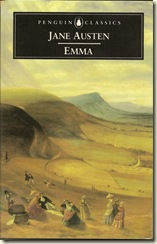
Here’s my copy.
It’s the previous edition of the Penguin Classics line.
It depicts a detail from some anonymous English artist’s painting “Picnicking at Devil’s Dyke, Newmarket”.
I don’t know about Devil’s Dyke, to me this scene depicts the pivotal Box Hill picnic from the novel.
It is a cover that feels like it has been chosen by someone who has actually read Austen, and knows her line about writing that “Three of four families in a country village is the very thing to work on”.
 Here we see the three or four families, on which she worked so fine a brush. I shall never buy another version.
Sometimes if a new edition comes out with a cover I like, I feel odd pangs while in the book store as I wish to buy it. The latest Penguin Classics version of Anna Karenina is a case in point. Here’s my current version on the right. It’s a good enough cover. The woman does look rather Anna Karenina like.
 But here is the latest version:
I want this copy! It makes my old copy look, well, old. The new one is vibrant, hints at the personality and the beauty of Anna.
I am trying to convince myself that I need this new version because it is also a new translation done by Larissa Volokhonsky and Richard Pevear.
The old copy doesn’t hold any sentimental value either, so all I have to do is convince myself I need a new copy of a book I already own (shouldn’t be too hard…).

Sometimes a cover doesn’t live up to what it suggests. Take the cover of Sue Woolfe’s Leaning Towards Infinity:
I have to admit I bought this novel basically because there was a photograph of a naked woman on the cover.
The blurb on the back about a housewife who happens to be a mathematical genius also intrigued me. The cover suggested something sensual and erotic – it’s a photograph from the 1920s, and the sepia tone seemed a nice contrast to the more harsh black and white covers around at the time (see The River Ophelia below).
But, I have to say I absolutely hated this novel. Hated it to the point of wishing the novel ill-health.
It seems like a book written for women who hate men. The prose was dull and lacking any poetic sense; the narrative structure, pointlessly contrived. It was a lesson for me that the cover cannot overcome the words inside. I sold it at a university second book sale that I used to be involved in running, and I felt guilty that I had allowed someone to buy it for a gold coin donation.
That said, it is a great cover.

Another cover, that is much better than the novel inside is Justine Ettler’s The River Ophelia. Written in the mid-1990s and was marketed as one of the “dirty realism” novels of the time. I was thisclose to buying it due to the great cover – a lovely matte finish that was popular at the time. But the blurb about it being a raw confronting tale of modern romance put me off.
A few years later I met a woman who had read the novel. I asked her if it was any good. She said the cover was better. But then maybe I should have bought it – to buy a second hand copy of it now on Amazon will set you back US$29.
Other interesting covers are ones that I wish I owned, but sadly, by the time I got around to buying the book a new edition had came out.
 On this score is an early version of Umberto Eco’s The Name of the Rose:

The calligraphy and the look of a faded manuscript perfectly captures the sense and meaning of the novel. It doesn’t even matter that the whole left side of the cover contains quotes from reviewers.
It sure beats the heck out of the copy that I have – one of the generic Eco covers that came out in the 1990s (on the right). And while I don’t mind that cover (I did buy the book after all), I have a friend in South Australia who I see every Christmas time who has a copy of the older version on his bookshelf.
And every year a tiny part of me thinks about stealing the copy!
I keep looking for it in second hand stores, but have never come across a copy with this cover in good condition.
But enough of this prelude; here are my favourite covers from my bookshelf (in no particular order).

Ken Kesey, One Flew Over the Cuckoos Nest
As a general rule I hate movie tie-in covers. Rarely are they any good and if the movie is rather sub-standard, then you want to do all you can to avoid any connection (did anyone ever buy the movie tie-in cover of Bonfire of the Vanities?)
But this one is different. Jack Nicholson’s portrayal of McMurphy is indelibly linked with the book. And the photo of Nicholson perfectly captures the character. The orange background somehow works as well – and the colour scheme is almost unique to this book.
This was the version of the book that I first read in Year 12, and when I wanted to buy the novel a few years later I made sure I got this version.

David Guterson, Snow Falling on Cedars
You know this is a good cover, because every edition of the novel, besides the film tie-in, has used this photo. This was the first version. I came across it in a small bookstore in Melbourne one cold wintery night in June 1996. My wife and I had flown down to Melbourne for a holiday from Cairns where we lived at the time. Good bookstores were (and still are) pretty thin on the ground up north, and so we spent many an hour perusing the book stores in the Victorian capital.
A friend of mine from Canada had written to me (this was before email) recommending the book. When I saw the cover in that small bookstore, with the rain pelting down outside, I felt its matte finish and I knew this was a book for me. And it was – a wonderful novel.
The photograph by Stuart Simons captures the narrative’s mood precisely. And looking at the cover now, I realise I haven’t read the book for well over a decade, and I think it may be time to dive back into the mists of the Washington coast.

Nikos Kazantzakis, The Last Temptation
I picked this copy up in 1996 as well, and is one of the great faber and faber covers that features the black box in the top left corner. They no longer do covers this way, but for a long time there you could tell that faber was the publisher just by looking at the cover.
This novel is an amazing trip – hauntingly poetic; almost hypnotising. The cover of thorns set against the red background is actually a film tie-in, though you wouldn’t know it (aside from the diagonal slash down the bottom).
It’s a book where any depiction of a face would be immediately too limiting, too stereotypical, or too fake. You can’t put a picture of Jesus Christ on the cover of a novel and expect to be taken seriously. This picture focuses on the crucifixion and the last temptation that would occur there. The tangle of thorns goes well with the tangled narrative and visions within.

Nikolai Gogol, Dead Souls
Penguin Classics used to have great covers. As a rule I hate their new look – with the black band across the bottom, and the image/ painting occupying the top two-thirds. When I started reading literature, the Penguin Classics were in this form on the right – the image took up the whole front and the black box was at the top. I am nostalgic for it still, and mostly because (as with Emma above) they haven’t improved on the previous version.
When I saw this copy with the detail of Repin’s painting of “Procession in the Province of Kursk” I wanted to buy it without caring what the book was about.
I had vaguely heard of Gogol, but it was the cover that sold me. And good thing to, because this is a great work. Perhaps with Byron’s Don Juan, the great unfinished work of literature.

Roddy Doyle Paddy Clarke Ha Ha Ha
A brilliant example of how a photograph can capture a narrative perfectly. I have no idea if the young lad in this photograph by Derek Spiers is Irish or was taken at the time in which the novel is set. But it is impossible not to think that it is.
This kid is Paddy Clarke – testament of which is that they have kept using it for subsequent editions.
It reminds me for some reason of the Boy and War U2 covers, and perhaps that is why it had such an Irish feel to me.\
But the delight conveyed in the photograph disguises the absolute heartache inside.
A great cover – whoever picked the photograph deserves a cut of the royalties.

Rohinton Mistry, A Fine Balance
Another example of a great photograph. This time however it doesn’t aim to depict a character, more the feel of the novel. I don’t even know if it does it; but it conveys something – that sense that there is a world that we in the west don’t know about. Here’s a young Indian child balancing on the end of a pole that is in turn being held up by someone’s thumb.
Why is this happening? What is the child reaching for? Can we understand? It’s beguiling and yet also troubling – much like the novel.
A great cover – and one of the few that is mostly white.
The book though is another matter – pure brilliance, but easily the most suicide inducing narrative I’ve ever read. The characters are absolutely trashed by events and circumstances, and it ends on a note of pure despair. I read this one Christmas holidays. It didn’t quite fit in with the spirit of the season.

Fyodor Dostoyevsky, The Brother Karamazov
Another great Penguin Classics cover that has not been improved with the new. In fact the detail of the painting by Repin (that man again) of “The Rejected Confession”, is now being used by the cheap “Wordsworth Classics” edition of the novel.
But the main reason I love this cover is the little white spot you see to the right of the priest’s head. That spot is a bread crumb that has been stuck underneath Contact since 1994.
At the time my wife used to cover my books with contact (she is a school teacher after all). This particular book was a very precious purchase of mine at the time, and so when she covered the book and then noticed the crumb she was somewhat concerned about my reaction. I cannot actually recall what I said, but I believe I may have expressed some questions about her ability to do a simple remedial task (a remedial task it should be said that has long been beyond me). She no longer covers my books – quite rightly reasoning if I want them done, I can bloody well do it myself.
And so when I look at this cover, it is that crumb that brings a smile, as I recall how anal I used to get (and admittedly still am a bit) about books, and how understanding my wife is of my obsessions. I wouldn’t trade this copy for anything; the painting induced me to buy it, but the crumb makes it a treasured item of my life.
And that’s why covers are important. The novels I buy become part of my life, so I always make sure I’ll want to look at them for many years to come.
I own over 500 books, and not one of them did I buy without considering the cover. No matter how good the writing, if the cover is bad, I’ll wait. I waited about 10 years before buying The Grapes of Wrath purely because I didn’t like the cover.
 Yes it is dopey, but it can’t be denied – and the publishers know it is true as well because they spend so much effort on trying to get the cover right. Just ask Louis de Bernieres how important a good cover is.
 So distinctive is the cover of Captain Corelli’s Mandolin by Australian artist Jeff Fisher that at the end of the film Notting Hill you can see from just a quick glimpse that it is the book Hugh Grant’s character is reading while sitting on a park bench with Julia Roberts. Apparently Fisher gets lots of requests for signed prints of the cover, and even de Bernieres acknowledged the cover “played a major part in speeding up the rate of my success”. Fisher got paid 600 Livre for it, the design company got the awards (and de Berniers the royalties).
My wife likes the book more than I do, but there’s no denying it’s a cracker of a cover.
Sometimes novels are put out in an array of covers to try and capture a certain section of the market; and it must work because I know there are some covers I ignore, and others I find irresistible.
Consider Jane Austen’s Emma. Here’s three different covers:

This one on the left screams “made for women who don’t like classics but who like chick-lit”. It came out as part of a series of generic covers of Austen’s novels; done no doubt in the hope that people will almost view them as sequels (in much the same way that say the second book by the author of The Devil Wears Prada has a similar style cover although the books have nothing in common but the author). I could never buy this book – mostly out of snobby condescension of the people to whom this cover is marketed.

The one on the right is the latest one to be done in the Penguin Classics series. You have to seriously wonder who was the blind git who chose this cover. If this is meant to be Emma Woodhouse, then I’m sorry, she doesn’t fit my picture of her.
This woman looks distinctly unappealing – why would anyone cross the room to talk to her? If I’m going to devote my time reading a novel for a month or so, I want to like the main character; and this woman is not someone I want to get to know. Yes Emma is an incredible snob; but this woman to me lacks any spark or joy that I love so much about Emma.

Here’s my copy.
It’s the previous edition of the Penguin Classics line.
It depicts a detail from some anonymous English artist’s painting “Picnicking at Devil’s Dyke, Newmarket”.
I don’t know about Devil’s Dyke, to me this scene depicts the pivotal Box Hill picnic from the novel.
It is a cover that feels like it has been chosen by someone who has actually read Austen, and knows her line about writing that “Three of four families in a country village is the very thing to work on”.
 Here we see the three or four families, on which she worked so fine a brush. I shall never buy another version.
Sometimes if a new edition comes out with a cover I like, I feel odd pangs while in the book store as I wish to buy it. The latest Penguin Classics version of Anna Karenina is a case in point. Here’s my current version on the right. It’s a good enough cover. The woman does look rather Anna Karenina like.
 But here is the latest version:
I want this copy! It makes my old copy look, well, old. The new one is vibrant, hints at the personality and the beauty of Anna.
I am trying to convince myself that I need this new version because it is also a new translation done by Larissa Volokhonsky and Richard Pevear.
The old copy doesn’t hold any sentimental value either, so all I have to do is convince myself I need a new copy of a book I already own (shouldn’t be too hard…).

Sometimes a cover doesn’t live up to what it suggests. Take the cover of Sue Woolfe’s Leaning Towards Infinity:
I have to admit I bought this novel basically because there was a photograph of a naked woman on the cover.
The blurb on the back about a housewife who happens to be a mathematical genius also intrigued me. The cover suggested something sensual and erotic – it’s a photograph from the 1920s, and the sepia tone seemed a nice contrast to the more harsh black and white covers around at the time (see The River Ophelia below).
But, I have to say I absolutely hated this novel. Hated it to the point of wishing the novel ill-health.
It seems like a book written for women who hate men. The prose was dull and lacking any poetic sense; the narrative structure, pointlessly contrived. It was a lesson for me that the cover cannot overcome the words inside. I sold it at a university second book sale that I used to be involved in running, and I felt guilty that I had allowed someone to buy it for a gold coin donation.
That said, it is a great cover.

Another cover, that is much better than the novel inside is Justine Ettler’s The River Ophelia. Written in the mid-1990s and was marketed as one of the “dirty realism” novels of the time. I was thisclose to buying it due to the great cover – a lovely matte finish that was popular at the time. But the blurb about it being a raw confronting tale of modern romance put me off.
A few years later I met a woman who had read the novel. I asked her if it was any good. She said the cover was better. But then maybe I should have bought it – to buy a second hand copy of it now on Amazon will set you back US$29.
Other interesting covers are ones that I wish I owned, but sadly, by the time I got around to buying the book a new edition had came out.
 On this score is an early version of Umberto Eco’s The Name of the Rose:
The calligraphy and the look of a faded manuscript perfectly captures the sense and meaning of the novel. It doesn’t even matter that the whole left side of the cover contains quotes from reviewers.
It sure beats the heck out of the copy that I have – one of the generic Eco covers that came out in the 1990s (on the right). And while I don’t mind that cover (I did buy the book after all), I have a friend in South Australia who I see every Christmas time who has a copy of the older version on his bookshelf.
And every year a tiny part of me thinks about stealing the copy!
I keep looking for it in second hand stores, but have never come across a copy with this cover in good condition.
But enough of this prelude; here are my favourite covers from my bookshelf (in no particular order).

Ken Kesey, One Flew Over the Cuckoos Nest
As a general rule I hate movie tie-in covers. Rarely are they any good and if the movie is rather sub-standard, then you want to do all you can to avoid any connection (did anyone ever buy the movie tie-in cover of Bonfire of the Vanities?)
But this one is different. Jack Nicholson’s portrayal of McMurphy is indelibly linked with the book. And the photo of Nicholson perfectly captures the character. The orange background somehow works as well – and the colour scheme is almost unique to this book.
This was the version of the book that I first read in Year 12, and when I wanted to buy the novel a few years later I made sure I got this version.

David Guterson, Snow Falling on Cedars
You know this is a good cover, because every edition of the novel, besides the film tie-in, has used this photo. This was the first version. I came across it in a small bookstore in Melbourne one cold wintery night in June 1996. My wife and I had flown down to Melbourne for a holiday from Cairns where we lived at the time. Good bookstores were (and still are) pretty thin on the ground up north, and so we spent many an hour perusing the book stores in the Victorian capital.
A friend of mine from Canada had written to me (this was before email) recommending the book. When I saw the cover in that small bookstore, with the rain pelting down outside, I felt its matte finish and I knew this was a book for me. And it was – a wonderful novel.
The photograph by Stuart Simons captures the narrative’s mood precisely. And looking at the cover now, I realise I haven’t read the book for well over a decade, and I think it may be time to dive back into the mists of the Washington coast.

Nikos Kazantzakis, The Last Temptation
I picked this copy up in 1996 as well, and is one of the great faber and faber covers that features the black box in the top left corner. They no longer do covers this way, but for a long time there you could tell that faber was the publisher just by looking at the cover.
This novel is an amazing trip – hauntingly poetic; almost hypnotising. The cover of thorns set against the red background is actually a film tie-in, though you wouldn’t know it (aside from the diagonal slash down the bottom).
It’s a book where any depiction of a face would be immediately too limiting, too stereotypical, or too fake. You can’t put a picture of Jesus Christ on the cover of a novel and expect to be taken seriously. This picture focuses on the crucifixion and the last temptation that would occur there. The tangle of thorns goes well with the tangled narrative and visions within.

Nikolai Gogol, Dead Souls
Penguin Classics used to have great covers. As a rule I hate their new look – with the black band across the bottom, and the image/ painting occupying the top two-thirds. When I started reading literature, the Penguin Classics were in this form on the right – the image took up the whole front and the black box was at the top. I am nostalgic for it still, and mostly because (as with Emma above) they haven’t improved on the previous version.
When I saw this copy with the detail of Repin’s painting of “Procession in the Province of Kursk” I wanted to buy it without caring what the book was about.
I had vaguely heard of Gogol, but it was the cover that sold me. And good thing to, because this is a great work. Perhaps with Byron’s Don Juan, the great unfinished work of literature.

Roddy Doyle Paddy Clarke Ha Ha Ha
A brilliant example of how a photograph can capture a narrative perfectly. I have no idea if the young lad in this photograph by Derek Spiers is Irish or was taken at the time in which the novel is set. But it is impossible not to think that it is.
This kid is Paddy Clarke – testament of which is that they have kept using it for subsequent editions.
It reminds me for some reason of the Boy and War U2 covers, and perhaps that is why it had such an Irish feel to me.\
But the delight conveyed in the photograph disguises the absolute heartache inside.
A great cover – whoever picked the photograph deserves a cut of the royalties.

Rohinton Mistry, A Fine Balance
Another example of a great photograph. This time however it doesn’t aim to depict a character, more the feel of the novel. I don’t even know if it does it; but it conveys something – that sense that there is a world that we in the west don’t know about. Here’s a young Indian child balancing on the end of a pole that is in turn being held up by someone’s thumb.
Why is this happening? What is the child reaching for? Can we understand? It’s beguiling and yet also troubling – much like the novel.
A great cover – and one of the few that is mostly white.
The book though is another matter – pure brilliance, but easily the most suicide inducing narrative I’ve ever read. The characters are absolutely trashed by events and circumstances, and it ends on a note of pure despair. I read this one Christmas holidays. It didn’t quite fit in with the spirit of the season.

Fyodor Dostoyevsky, The Brother Karamazov
Another great Penguin Classics cover that has not been improved with the new. In fact the detail of the painting by Repin (that man again) of “The Rejected Confession”, is now being used by the cheap “Wordsworth Classics” edition of the novel.
But the main reason I love this cover is the little white spot you see to the right of the priest’s head. That spot is a bread crumb that has been stuck underneath Contact since 1994.
At the time my wife used to cover my books with contact (she is a school teacher after all). This particular book was a very precious purchase of mine at the time, and so when she covered the book and then noticed the crumb she was somewhat concerned about my reaction. I cannot actually recall what I said, but I believe I may have expressed some questions about her ability to do a simple remedial task (a remedial task it should be said that has long been beyond me). She no longer covers my books – quite rightly reasoning if I want them done, I can bloody well do it myself.
And so when I look at this cover, it is that crumb that brings a smile, as I recall how anal I used to get (and admittedly still am a bit) about books, and how understanding my wife is of my obsessions. I wouldn’t trade this copy for anything; the painting induced me to buy it, but the crumb makes it a treasured item of my life.
And that’s why covers are important. The novels I buy become part of my life, so I always make sure I’ll want to look at them for many years to come.
Subscribe to:
Posts (Atom)