Thursday, June 9, 2011

Steady as she softly grows

Another day another set of economic data. Today it was the turn of the employment figures top come out. image

image

On the very surface things looked OK. The unemployment rate stayed steady at a seasonal rate of 4.9% (though if you want to get down to the decimal points in April it was 4.859339% and in May it rose to 4.9265151 – so it actually rose 0.067% so it is only a rounding quirk that there was not an increase (for example it rises by the same amount next month, the rounded figure will be 5.0%.

But let us keep with the rounding for now, and say that unemployment remained steady. Let’s have a look at employment:

Employment increased 7,800 (0.1%) to 11,440,500. Full-time employment decreased 22,000 to 8,027,100 and part-time employment increased 29,800 to 3,413,500.

So the “steadiness” of the unemployment rate was due to an increase in part-time employment making up for the fall in full-time employment.

When such thing happen, it is always good to have a gander at the Labour underutilization figures – ie those who want to work but have no work, or those who have a job but want to work more. First the long term rate (since 1978)

image

Not surprisingly it largely mirrors the unemployment rate, and you can also see that it rarely gets below 10%. The average since 1978 is actually 12.1%.

Let’s have a look at it over the past 5 years:

image

It shows that just before the Global Financial Crisis smacked us around, it was at that historically low 10% level, but now it is at 12.2% – ie just above that long term average.

It means that we are not at “full employment” by any means. 4.9 per cent employment is quite healthy – and well below the average since 1978 of 7.1 per cent, but there are a lot of people who want to work more than they currently are. 

If we then look at actual employment growth we see this weakness in the labour market as well.

Now if I was silly I would just show this graph and say wow, look at all the extra people who are being employed compared to 1978:

image

But such a nominal graph like that is pretty meaningless, and no one would be so silly as to look at nominal figures without taking into account population growth...

So let’s focus on the percentage change in employment in the last 5 years to actually see what is going on in the labour market:

image

As you can see, after the trough of the GFC in 2008-09, there was very good strong growth in employment to the end of 2010, but that 3 of the last 6 months has actually seen a decline in seasonally adjusted total employment, and the quarterly average is now near zero per cent growth.

Now to an extent this is not unexpected. After all we have just come out of a shocker of a quarter in terms of GDP. It was also a period where productivity sharply declined – because the GDP slumped, but companies, especially in QLD, knew it was only temporary slump due to weather etc, and so did not lay off masses of staff. And so now as production starts up again, there is not the type of need to re-employ staff to so the work that you might find as an economy moves out of a quarter of negative growth – they are already working.

But the decline in employment growth since the peak spurt in November 2010 shows that there does appear to be a softness in the market. A softness, however that suggests the RBA will be unlikely to put on the interest rates break. (the usual economic play – something bad means something good)

The market has reflected this belief as well – and lingering thoughts that the RBA might increase the rates next month has completely disappeared.

image

It’s why the exchange rate decline a little bit in the past week:

image

But we’re still well over parity. Why are we still so high if it is unlikely for the cash rate to be increased? Well because while the growth is weak at the moment, the belief is that once the full effects of the floods and Cyclone Yasi are gone the growth will fire up – and so too will inflationary pressures (and thus the cash rate).

For the other reason, we need to visit our American cousins and see how they’re fairing in comparison:

image

And that horror is why Obama is very much a chance to be like George Bush Sr, and be a oncer. Bush Sr also had a nice military victory to boast of, just as Obama did with getting Osama bin Laden, but Bush Sr fell victim to Clinton and his “It’s the economy stupid” campaign. Obama if he is going to win in 2012, will need to fight on that same battlefield.

Labor will of course be fighting that battle as well – unlike Obama though it has (and will have) a good story to tell… it just needs to work out how to tell it.

Wednesday, June 8, 2011

The sublime and the ridiculous: Barnaby at Estimates

Episode 1,582 of the mining companies are talking out their backsides when they say the minerals resources rent tax and the carbon tax are going to kill the industry: “Today's Mineral Exploration Figures released by the ABS:

imageLet’s review the comments to see if the ABS has stuffed up and has the graph upside down:

The trend estimate for total mineral exploration expenditure rose 8.8% (or $60.7m) to $748.8m in the March quarter 2011. The current quarter estimate is 31.1% higher than the March quarter 2010 estimate.

Gee, 31 per cent higher than this time last year. That seems odd…

Well obviously it must all be petroleum – we know the Pilbara is finished, so let’s have a gander at the figures with the petroleum out of the equation:

MINERAL EXPLORATION (OTHER THAN FOR PETROLEUM)
EXPLORATION EXPENDITURE
The seasonally adjusted estimate of mineral exploration expenditure rose 22.2% (or $144.9m) to $797.4m in the March quarter 2011. The largest rise this quarter was in Western Australia (up 25.4% or $92.1m), followed by Queensland (up 17.4% or $22.9m).

Oh.

Well… I guess they’re just doing a heap of exploring on the expectation the carbon price and MRRT won’t come in… oh and yeah, they also would’ve been doing a lot more if both industry and economy killing taxes weren’t being brought in…

Yeah… we’ll go with that. That sounds plausible.

After that idiocy let’s get to the silliness… I give you the next instalment of everyone’s favourite sitcom: Barnaby Joyce Goes to Estimates:

Let’s start off on the day of the big meow. Joyce wanted to get stuck into Treasury Secretary Dr Parkinson on the issue of the GDP figures.

Senator Wong: Thank you, Madam Chair. Those questions go to Climate Change; I think some of them were asked. Treasury, as Ms Quinn has outlined, is undertaking economic modelling in relation to mitigation policy.

Senator JOYCE: Marvellous stuff. We have had a negative quarter of growth, Dr Parkinson; why is that?

Dr Parkinson: We had a negative quarter of growth in 2001; is that what you are talking about?

Senator JOYCE: Aren't we just announcing figures today that are going to show—

Senator Wong: The national accounts will be announced at 11:30.

Senator JOYCE: Sorry?

Dr Parkinson: The national accounts will be out later today.

Senator JOYCE: Everybody knows about them. I can even tell you the figure.

Bear in mind this was about 10:30 in the morning, so “everybody” knowing the figures seemed rather an odd call by Barnaby.

Dr Parkinson: If you know the figure, I am sure that the statistician will be interested to know that—

Parkinson isn’t going to let it go though to the keeper – given that it would actually be a pretty serious offence for someone to leak the National Accounts, given the impact they have on markets.

Senator JOYCE: Would you be surprised if we had a negative—

Senator Wong: Senator Joyce, he had not finished.

Dr Parkinson: because that would be a violation of the way in which—

But not to worry, Barnaby is not concerned – because how does he know the exact GDP growth figures before they are officially released?…

Senator JOYCE: It was in the paper.

Uhuh.

Dr Parkinson: It might be reported in the paper, Senator, but I—

Senator JOYCE: Well, how did it get out?

Senator Wong: Senator—

Dr Parkinson: Senator, excuse me!

Parkinson was not going to let Joyce off lightly. …

Dr Parkinson: The statistician will release the national accounts later this morning.

Senator JOYCE: How is it reported in the paper? How did it get out, Dr Parkinson?

Dr Parkinson: Senator, what has got out?

Parkinson at this point is rather curious as to what the hell Barnaby is talking about, given it is pretty obvious to everyone with an IQ above tepid water temperature levels that when economists in the newspaper say they estimate the GDP to fall they are… well… estimating…

Senator JOYCE: Apparently we are heading towards a negative quarter of growth, at about 0.4 per cent?

Dr Parkinson: That is your estimate, is it, Senator?

Senator JOYCE: Well, that is what is in the paper; is that right?

Dr Parkinson: Senator, I do not believe most things I read in the paper.

Quite possibly the line of Estimates.

Senator JOYCE: It will be interesting to know around about where it is, because the question will be: how did it get out?

Dr Parkinson: Senator—

Parkinson at this point is going to pretend he thinks Barnaby is not a complete idiot:

CHAIR: Senator Joyce, do you have another question? We have other senators waiting.

Dr Parkinson: Senator, you are actually making a very, very serious allegation. I do not know whether you realise it, but you are implying that somebody has leaked the national accounts. If you have any evidence, I would have thought it was incumbent upon you to report that to the AFP and the Statistician.

OK maybe the “I do not think you realise it” part suggests he was perhaps assuming Barnaby was a little bit of an idiot.

Senator JOYCE: Then I would report to them that they should read paper, Dr Parkinson, because that is where it is!

At this point Parkinson allows David Gruen off his leash. Gruen was already nicely warmed up from a session earlier in the morning where he had patiently explained the Senator Cormann how economic modelling works – and in the process also explained that factors like the aging of the population is actually a much bigger impact on the economy than will be a carbon price.  Gruen was going to go through it for Joyce like Joyce was a 5 year old:

Dr Gruen: Senator, what are reported in the paper, at least as I have read it, are market economists' estimates of what they think will be the March quarter outcome. That has been reported in the papers on the morning of the national accounts release for as long as I have been reading these things—which is quite a long time. There are a large number of partial indicators that have already been published; for instance, the balance of payments was published yesterday. There are a large number of partial indicators that enable market economists to make an educated guess of what they think the national accounts will be. There are a range of estimates. Many of those, as you correctly state, are that real GDP will have fallen in the March quarter; that is all true. That is different from saying, as we have taken you to say, that the papers report on what the national accounts will be. They simply report on what private market economists are estimating will be the national accounts for the March quarter.

Parkinson adds in his final point:

Dr Parkinson: And, if you read the papers in the week or the two weeks beforehand you will see quite a number of estimates, as market economists change their own forecasts for what they expect to see in the national accounts. But I go back to my point: if you believe the national accounts have been leaked, I think that is a very serious issue and I would urge you to raise with it with the Statistician and with the AFP.

Here, Joyce decided he should move on…

I should mention that when the GDP figures came out the result was negative quarter growth of 1.2. I guess that leaked figure that Joyce was putting so much store in was not exactly on the money.

The next day the episode continued but I shall leave that instalment for another day. But just remember the first thing Tony Abbott did was appoint Joyce as his Finance spokesperson (an appointment so bad, even Abbott came to realise his fault). I guess “everything was different then”.

Tuesday, June 7, 2011

What’s eating you?

So The Reserve Bank announced that it was keeping the cash rate at 4.75 per cent. This did not surprise too many economists – especially after the GDP figures and yesterday’s job adverts. Christopher Joye (ever the inflation hawk) thinks the RBA almost certainly will have to raise them in July. But the language of the RBA suggests to some that it is less inclined to that view. Back last month, here’s how the Governor’s statement ended:

The Bank expects that, as the temporary price shocks dissipate over the coming quarters, CPI inflation will be close to target over the year ahead.

Looking through these short-term movements, however, the recent information suggests that the marked decline in underlying inflation from the peak in 2008 has now run its course. While the rising exchange rate will be helping to hold down prices for some consumer products over the coming few quarters, over the longer term inflation can be expected to increase somewhat if economic conditions evolve broadly as expected.

At today's meeting, the Board judged that the current mildly restrictive stance of monetary policy remained appropriate. In future meetings, the Board will continue to assess carefully the evolving outlook for growth and inflation.

This month it ended this way:image

CPI inflation has risen over the past year, reflecting the effects of extreme weather and rises in utilities prices, with lower prices for traded goods providing some offset. The weather-affected prices should fall back later in the year, though substantial rises in utilities prices are still occurring. The Bank expects that, as the temporary price shocks dissipate over the coming quarters, CPI inflation will be close to target over the next 12 months.

At today's meeting, the Board judged that the current mildly restrictive stance of monetary policy remained appropriate. In future meetings, the Board will continue to assess carefully the evolving outlook for growth and inflation.

Yeah, big difference I know – the absence of”marked decline” and change from “increase somewhat” to “close to target”.

I love how the Governor's statements are raked over by pundits – all searching for some sort of clue. Note as well that the last paragraphs are exactly the same. This is pretty common, and is why the ‘experts’ (and bloggers) look for every little difference. Take this from last month:

Growth in employment has moderated over recent months and the unemployment rate has been little changed, near 5 per cent. Most leading indicators suggest further growth in employment, though most likely at a slower pace than in 2010. Reports of skills shortages remain confined, at this point, to the resources and related sectors. After the significant decline in 2009, growth in wages has returned to rates seen prior to the downturn.

Now compare to this month:

Growth in employment has moderated over recent months and the unemployment rate has been little changed, near 5 per cent. Most leading indicators suggest that this slower pace of employment growth is likely to continue in the near term. Reports of skills shortages remain confined, at this point, to the resources and related sectors. After the significant decline in 2009, growth in wages has returned to rates seen prior to the downturn.

Hmm what is the difference between “further growth in employment, though most likely at a slower pace” with “this slower pace of employment growth is likely to continue”??

As the double rainbow guy would say, What does it mean?

Well who knows. The thing is the RBA knows everyone is ruminating over and insinuating into each differing word more meaning than they most likely have, so it generally keeps things pretty neutral. Take for example how it compares its expectations of the result of the floods and cyclone on GDP with what happened. Back in May:

The natural disasters over the summer have reduced output in some key sectors and the resumption of coal production in flooded mines is taking longer than initially expected. It is likely this caused a decline in real GDP in the March quarter. Production levels should, however, recover over the months ahead, and there will be a mild boost to demand from the rebuilding efforts as they get under way. Over the medium term, overall growth is likely to be at trend or higher.

And now:

The floods and cyclones over the summer have reduced output in some key sectors. As a result there was a sharp fall in real GDP in the March quarter, despite a solid increase in aggregate demand. The resumption of coal production in flooded mines is taking longer than initially expected, but production levels are now increasing again and there will be a mild boost to demand from the broader rebuilding efforts as they get under way. Over the medium term, overall growth is likely to be at trend or higher.

In other words things happened the way we expected them to happen (and in case you missed it last month we think “over the medium term, overall growth is likely to be at trend or higher”).

The general outlook of Australia’s economy have not changed much either. In May:

Australia's terms of trade are reaching higher levels than assumed a few months ago, and national income is growing strongly. Private investment is picking up, mainly in the resources sector, in response to high levels of commodity prices. In the household sector thus far, in contrast, there continues to be caution in spending and borrowing, and a higher rate of saving out of current income.

In June:

Australia's terms of trade are reaching very high levels and national income has been growing strongly. Private investment is picking up, led by very large capital spending programs in the resources sector, in response to high levels of commodity prices. Outside the resources sector, investment intentions have been revised lower recently. In the household sector thus far, there continues to be a degree of caution in spending and borrowing and a higher rate of saving out of current income.

The big difference is the highlighted sentence – the rest is the same (if not verbatim) in both paragraphs. This sentence could be read as a bit of an acknowledgement of the “two-speed economy” TM, but is not exactly suggesting that things are tanking outside the mining sector.

One thing the RBA has also been consistent on since 2009 is the fiscal impact of the stimulus:

The impetus from earlier Australian Government spending programs is now also abating, as had been intended.

What I think we can take from the whole of this statement is that if (like Joye and others) you think the RBA should/will raise rates soon, then there is not much reason to alter that view; if you don’t, then you can probably keep that view as well. Some say the RBA should not have the market guessing, personally I think the guessing really only occurs because we trip over every word looking for certainty. For mine, I think economics and life ain’t certain. 

And on a side note, it’s good to see that the APS habit of cut and paste is also alive and well in the RBA!

***

Today Wayne Swan released some economic modelling on the impact of the carbon tax (well at least if it was set at $20 a tonne which it likely won’t be) in a speech at the National Press Club. He revealed the impact on income:

The modelling will show real national income growing strongly under a carbon price, at an average annual rate per person of around 1.1 per cent until 2050 instead of 1.2 per cent. This means a carbon price would only reduce annual growth in GNI per person by about one-tenth of 1 percentage point.

He was also on Fran Kelly this morning where he said:

KELLY: And if my maths is correct, and that's no means a given, it would be a small difference wouldn't it?  If it's a hit to the national economy of 0.1 of 1 per cent.

TREASURER: That's right.

KELLY: Then 0.1 per cent of $65,000 is $65.00 per annum.  Is that the cost of a carbon tax to each of us?

TREASURER: Well, it's a relatively small amount of money Fran, and that's the whole point.  The modelling shows that we can grow our economy strongly, grow national incomes and not have a significant impact overall on those individual incomes.

So $65 a year for someone on an income of $65,000… zero point one per cent… Not exactly big. So how did The Oz report this?

TREASURER Wayne Swan has conceded the carbon tax will eat into Australian's incomes, as he prepares to address the National Press club today to head off Tony Abbott's cost of living campaign against the tax.

Really? “Eat into Australian’s incomes”? I’m not sure what journalist Lanai Vasek is eating but at $65 a year, I’m guessing it ain’t much.

The interesting aspect of The Oz suggesting that such a figure may be a hit on “Australian's incomes”  is that today they announced from October they will be putting up a paywall for The Oz that will cost $2.95 per week or $153.40 per year.

Oddly the story in The Oz announcing this plan did not use words like “gouge”, “eat”, “strip”, “slug”, or “slap” that are usually applied to anytime the Govt seeks to take away any small bit of welfare or increases in any small way the “cost of living”.

But hey I guess if we can all afford $153, then $65 ain’t too much…

Incidentally I most likely will pay the amount – $2.95 is not much (though I wish I had an iPad – to make use of the app), but I might first see just how much (and more importantly who) they keep locked away. And also it will be interesting to see how much of their “exclusives” get picked up by other outlets. They may, for eg, keep the full Newspoll figures behind the paywall, but I bet by about 2 seconds after they are released I’ll know them from Twitter (in fact, given the Ghost Who Votes, it’ll be known on Twitter before hand).

I agree with those who say there needs to be found an on-line model that enables news organisations to get money (well if you ignore the fact that Crikey has been doing it for 10 years, and I’ve been paying them for 3 years). What I don’t agree with though is journalists who act like we consumers are cheap sponges who just want something for nothing. It wasn’t my company who decided 15-20 years ago to start giving away its content for free – that journalists’ employers did not attribute any value to their on-line labour is not their reader’s fault. And in the free market, the worth of something is what consumers are prepared to pay for it. I am quite interested to see what The Oz thinks people will pay for and what it thinks needs to stay free.

Friday, June 3, 2011

Friday Night Relaxer: Vale Borders

I first encountered Borders in 2001 when my wife and I visited friends who were living in Vancouver. I think I spent about 3-4 hours in the Borders and I probably drooled most of the time. So I was a bit sad to hear this week that all the stores in Australia were closing.

Back then in 2001 I was in total awe.

My God the books!

Living as I did in Cairns at the time, which is not exactly replete with City Lights type bookstores, it was a joy to be in a place where I could think of a book I had been searching for in Australia and voila there it was (so yep, thank you I will buy that copy of The Making of the Atomic Bomb by Richard Rhodes). I bought my cup of coffee, read a magazine, then sauntered off around the store, found a collection of William Goldman’s essays from Variety (The Big Picture), sat down in one of the very comfy chairs, and read the whole thing.

I then bought it.

I read another book – and also dozed for a bit (we had arrived the previous day and I was pretty jet-lagged), and then went searching and found a copy of The 42nd Parallel by Jon Dos Passos (bought it), and left thinking this is as close to heaven as I’m going to get.image

I’ve always loved bookstores. When I was a kid and we’d go shopping in Adelaide I would happily stay in a bookstore while my parents went off around the rest of the Westfields. At that stage I wasn’t even that big of a fiction reader, but I would happily look at the books on sport, or biographies or history section. Even the crappiest chain store bookstore was bliss for me.

When I went to Japan as an exchange student this love continued as I found some excellent bookstores in Tokyo that had copious amounts of English books – it was actually that year that I really discovered fiction.

And so when I encountered Borders in Vancouver and another in LA and the Barnes and Noble in San Francisco (and also the magnificent City Lights), I was as happy as a book lover could be (apparently there were other sites in Vancouver, LA and San Fran which also made the trip worthwhile).

When Borders opened in Adelaide, I was rather overjoyed as each year when we went home for Christmas I would stock up on books. Though if I was honest, the Borders in Adelaide didn’t change my buying habits much because I would often end up buying the books from the great Imprints bookstore on Hindley Street or the Mary Martin Bookshop on Rundle Street. If I am also honest, the Borders in Adelaide (and the one in Sydney) never really had that great welcoming vibe that did the bookstore in Vancouver. Neither store ever had the come on in and saunter around, grab a book and have a read, buy it if you like it vibe.

They sold coffee though. Gloria Jeans coffee…

When the Canberra store opened however things did feel better – it was just one floor – a wide open expanse. It had a great kids section where someone would often be reading stories on weekends, and my book crazy 5 year old (at the time) daughter was in raptures. It was her absolute favourite store (this was before she discovered Smiggle).

But as time passed I realised that we would go each week and let my daughter do some colouring-in and browsing of the kids books, but my browsing became less and less, because the content in the shop began to shrink. A shelf here and there was taken away. It wasn’t much, but it was noticeable. It went from being a store where I could come across a book I would likely not find anywhere else to one where I would say – you’re kidding they don’t have a copy of Bleak House? No Crime and Punishment?? No Solzhenitsyn at all???

We would buy a book for my daughters (they had a good supply of the “That’s Not My…” books that my youngest loves). But I stopped buying. A couple years back I wrote a blog post called Ten Books Needed in the Perfect Bookstore. It was a bit of a response to Borders lack of content.

imageBack then I also wrote  a blog titled How Much does that Book Cost? in which I despaired at the lack of logic in the price of books, noting that in Borders a copy of Winton’s Cloudstreet which came out in 1991 cost $29.50, but his latest work Breathe (which had just been published) cost $27.50. And of course a couple shelves away I could get Our Mutual Friend for $18.99, but Oliver Twist for $9.99.  

I wrote how I could go next door to JB Hi Fi and find logic in the price of DVDs and CDs (you never for example expect to pay more for Achtung Baby which came out in 1991 than U2’s latest album – unless it was a special remastered re-issue, and even then it would likely be the same price as the latest release not more). Similarly you don’t pay more for the DVD of the first Harry Potter movie than you do for the most recent.

Logic. Wonderful thing.

But of course that is not the only reason I stopped buying books there – the actual prices themselves were absurd. With the Australian dollar where it is shopping at The Book Depository with its lovely nil shipping charges is just too good to resist.

Booko has become one of my most visited sites as I compare prices across the world and buy with a couple clicks.

The close of Borders will nonetheless be a sad occasion, but when I went in on Wednesday lunchtime after hearing the news that it was closing the place felt pretty soulless. And what’s more the 20% off didn’t make anything more enticing. I grabbed a couple kids books for my youngest daughter. Went looking to see if a copy of Barnaby Rudge was there (one of the few Dickens I don’t own), it wasn’t. And so I left.

It will be sad because the place will leave a big hole in my daughter's life – she truly loved racing down the back to the kids’ area. But for me, the book addict, it won’t cast too much of a pall. I will still go out each weekend to the great second hand bookstores around Canberra,  and also to the fabulous Book Grocer in Kingston which is staffed by people who know books, and which has great books at great prices – $10 for a copy of Roger MacDonald’s 1915, why thank you, yes I will buy that!

There are a number of reasons why Borders failed. Yes the Parallel Import Restrictions play a part – but that doesn’t explain why Borders in the US also went belly-up. It is bizarre to think we could even care that Borders is going. Its demise perhaps makes You’ve Got Mail now officially the most dated movie of the 1990s – remember the book chain owned by Tom Hanks that run Meg Ryan’s little bookstore out of town was modelled on a Border’s type chain – so now, not only is no one meeting anyone through email, neither are massive bookstores chomping away the little guy.

Obviously the internet beat Borders. But I don’t think it did itself any favours. Borders reminds me a bit of Channel 9. Under Packer Nine was always the biggest and the best. Yes it made a profit, but being Number 1, and the biggest and the best seemed more important than being the most profitable. Let Channel 10 play the low revenue, low cost game. Nine was big. And then it was sold to bean counters who slashed and burned as they tried to cut costs and make a profit and well being “Still the One” seemed less important. And so the ratings absolutely tanked across the board.

Borders had to be big, and had to be well stocked, had to offer big service – story readings, coffee, comfy chairs. You had to want to go there because it was BIG. In the last couple years, yeah it’s been big in size, but has felt small in scope.

Floor space is pointless if there feels like more space than books.

But maybe bookstores are dying. I still seem to spend plenty of time in them – the Dymocks in Canberra central is nice and has a “we know books” vibe. So too does the Paperchain bookstore in Manuka (another favourite of mine). If the big bookstores are dead, but the smaller, independent ones (even though I know Dymocks is not) remain, I don’t think that will be too bad a thing. 

Have a relaxing weekend (I know I’ll be relaxing in a bookstore).

Wednesday, June 1, 2011

On the QT: No blog.. sort of

Sorry all – family life interrupts. No blog tonight… err except this blog saying that there is no blog.

Oh bugger it, a few quick things:

The Bushby saying “meow” to Wong thing in Senate Estimates was interesting but hardly needed a thorough going-over in Question Time by Tanya Plibersek. The media already had the vision and were going to run hard with it (it sure as hell negated any need on their part to listen to anything else said in the Estimates committee). And actually I don’t think Penny Wong needed any help. Her response to Bushby (and then to Brandis with his weak attempt to fudge the issue) was perfect:

She showed a hell of a lot more restraint than I would have.

Unfortunately what was missed in the focus on this was the Treasury – especially the Secretary Martin Parkinson and Head of Macroeconomics David Gruen – were adopting a very much more assertive approach than even seen by Ken Henry when he attended Estimate. Henry would often suggest his mirth at the idiocy of questions from Senators with a long pause and then a “I’m not sure that’s right Senator” type line. This morning Parkinson and Gruen would not let any off hand remark go through to the keeper.

Mathias Corman was given a lesson in economic modelling by Gruen, and Parkinson fairly well flew at Barnaby Joyce when Joyce rather idiotically suggested the National Accounts figures had been leaked because they were all in the newspapers (Joyce seemed not to grasp the difference between an economists estimate of the numbers and the actual numbers). Actually Joyce’s demeanour was just as disrespectful as Busbhy – but in some ways worse, because it displayed not just ignorance of how to act like an adult, but also ignorance of the law and basic economics.

When the Hansard comes out I might give it a bit deeper going over.

The GDP figures did come out, and yeah they were not great:

image

Why did they turn out so bad (minus 1.2% for the quarter)?

image

Yeah mining in QLD tanked due to the flood and Cyclone Yasi (and as an aside the contemptuous way Joyce in Estimates referred to the cyclone and the floods was fairly astonishing for a Senator of Queensland).

But worry not (well at least about GDP and the mining sector) because look at the terms of trade:

image

Yep. They’re pretty amazing.

What does it mean for interest rates? The market did not exactly get scared by the figures.

image

There’s still more chance there won’t be a rise in the cash rate next week, but it is not beyond the realms of possibility (though I would bet against it – on the back of the GDP slump, I think a rate rise would not do wonders for consumer confidence – especially when you look at how much we are saving:

image

It looks like a lot of people are deleveraging (perhaps baby boomers plunging back into their super to make up for the wipe out in 2008-09), and also people not feeling the most safe about life. But the RBA will sit down and say – yeah we know there were floods and a cyclone, but geez, we’re still looking good. That fact is why nowhere will you read anyone talking about recessions today.

While we’re here, let’s see how that union-led wages breakout is going (you know the ones that we were told would kill the mining industry once WorkChoices was removed)

image

Or this:

image

Hmm. Don’t you hate it when the facts don’t match your argument?

And as for Question Time? Let’s just say Harry Jenkins may have the confidence of the house, but he doesn’t have its respect.

And that is me not writing a blog.

Tuesday, May 31, 2011

On the QT: One sentence is not a report

imageThe parliamentary nonsense started this morning with the latest Newspoll coming out in The Oz showing that the the ALP’s 2PP vote had increased 2 points and narrowed the LNP’s lead from 46-54 to 48-52.

Naturally this was reported as “Coalition’s Election Winning Lead Survives Internal Squabbling” and had Dennis Shanahan writing that “ALP Fails to profit from Lib ructions”. You can see this poll prominently there on the front page of The Oz… well if by “prominently” we mean squeezed into one lousy column over on the right. 

Apparently Hockey and Turnbull having a bit of fit in one week was, according to Shanahan, meant to destroy his leadership and put the ALP back in front. Yeah right.

But hey, when you need to make up a story that has Abbott looking, it is always best to start with a strawman.

On the personal ratings, the poll confirmed what everyone knows – no one likes either Abbott or Gillard.

The poll – like all polls – of course is flawed due to the premise of asking who would people vote for were an election held on the weekend, and we can pretty much bank on there not being an election till late 2013. The ALP will hope that is long enough to get enough people to change their minds; the LNP hope it is not so long that people will start to use them.

imageThe poll was pretty well ignored because of two things that, unlike polls, dealt with real things that matter.

Firstly the announcement of the deaths overnight of two soldiers in Afghanistan. Such events always immediately serves to make politics so putridly stupid – especially when the politics seems not to include discussion of this real thing that matters.

The graph on the left shows the deaths in Afghanistan of coalition military servicemen and women.

The trend ain’t good.

Is it going to get better? Is it worth sticking out? I suspect there are a few on both sides of the political aisle who are having private reservations but both the ALP and LNP are trapped in a “can’t debate it” mode, for fear of looking like they are advocating “cut and run” or God forbid, suggesting that any of the 26 Australian servicemen will have died in vain.

When a death occurs, both sides adopt the appropriate tone, and we certainly mourn the loss and feel for their families. But we seem to dismiss debate. I have always been behind the Afghanistan War. It was a just war, and had Bush and Co not decided to go wandering off to Iraq in March 2003 there actually was a chance of success (just look at the casualties back then). But now?

How will we really know we have achieved success? Better still, how will we know we have failed?

Surely the lives of the men fighting and dying for their country deserve us having a bit a of a proper discussion about it. I doubt we’ll get one any time soon.

The other big discussion was that via Ross Garnaut, who announced his final review. It came in at 244 pages, and his summary a nice brisk 48 pages. So you’d figure that with all that meat the debate in Parliament would be pretty solid.

Well you would if you had never watched Question Time before.

Tony Abbott opened proceedings with a quote from Page 17 of the summary:

Australian households will ultimately bear the full cost of a carbon price.

He (and Hockey and Bishop after him) thought this belled the cat and also had shown Gillard and Swan (and I guess Combet) to be liars for saying that the carbon tax will be paid by the top 1000 polluters.

Sigh.

Yep, this is where we are.

Firstly no one since this debate has started has suggested the cost of putting a price on carbon won’t be passed on to consumers. Here is Julia Gillard back on 1 March in Parliament:

Ms GILLARD —… We will put a price on carbon, a price on every unit of carbon pollution. It will be paid for by businesses and as a result, because our business community is smart and adaptable and innovative, they will work out ways of pursuing their business and generating less carbon pollution. They will work out ways of making sure they pay less of a price when carbon is priced. Then they will enter into contracts, they will make investments on the basis of understanding the rules and understanding that carbon will be priced. And as they go about making those transitions, innovating, making the new investments of the future, we will work with those businesses in transition to a clean economy.

Having priced carbon and seen that innovation, yes, there will be pricing impacts; that is absolutely right. That is the whole point: to make goods that are generated with more carbon pollution relatively more expensive than goods that are generated with less carbon pollution. But because we are a Labor government this will be done in a fair way. We will assist households as we transition with this new carbon price.

Or then there was this on 21 March:

Ms GILLARD —Thank you very much, Mr Speaker. As I was indicating, the division here is whether you want to put a price on polluters and give assistance to households or whether you want to take money off households and give assistance to polluters. We will put a price on pollution. That price will be paid by polluters. We will generously assist households for the price impacts that they will experience. I have been very upfront about that.

One of the best things in my opinion in this debate has been that Gillard has not been afraid to state that a carbon tax will make prices go up. For Abbott, and other Liberal shills to suggest Garnaut’s report says something new, or something opposite to what Gillard or Swan or Combet have been saying, requires indulging in the most absurd levels of self-delusion.

The reason of course Abbott is making this argument is because he wants people to think a carbon tax is like a GST – in that 10% gets added on at the checkout – or even worse, like income tax, and so each fortnight people will see a deduction from their pay. It is not in Abbott’s interest to deal with facts. Facts are awful for Abbott – expect him to continue to steer well away from them.

The next bit of “gold” for Abbott was Page 77 (this time in the full review) where Garnaut writes this:image

In the long run, households will pay almost the entire carbon price as businesses pass carbon costs through to the users of their products.

Again we should file this under “No sh*t Sherlock, see above”. But no, he thought he had nailed Gillard with this.

Gillard responded by saying Abbott was:

… misrepresenting the force of Garnaut’s words. You can’t rely on one sentence and ignore the force of others…  Instead of looking at the occasional words reads the whole lot.

Well let us not read the whole lot, let’s just look at some words from the very same page Abbott was citing:

Using direct action measures to achieve a similar amount of emissions reduction would raise costs much more than carbon pricing, but would not raise the revenue to offset or reduce the costs in any of these ways. The costs might be covered by budgetary expenditure, but this affects who pays the costs, not whether the costs are there. Other people’s taxes have to rise to pay for expenditures under direct action.

Oddly Abbott didn’t quote that part. Or how about:

In addition, unlike regulatory or direct action measures, a market-based mechanism can collect revenue in a way that is more efficient than some existing taxes, for use in raising productivity, promoting equity, encouraging innovation in low-emissions technology, providing incentives for sequestration in rural Australia, and easing the transition for trade-exposed industries.

Hmm, nope – guess Tony must has skipped over that paragraph. Oh heck, let’s be bold and even read on a few more pages further (page 79):

A carbon price has some short-term negative effects on productivity growth and incomes—although less than direct action that secures similar reductions in emissions.

The summary is not Abbott’s friend either:

We would be damaged in other ways, too, if we sought to do our fair share through direct action. We would rely on the ideas of a small number of politicians and their advisers and confidants. While some of these ideas might be brilliant, in sum they would not be as creative or productive as millions of Australian minds responding to the incentives provided by carbon pricing and a competitive marketplace.

That would not be the end of the costs.

The really big cost would be the entrenchment of the old political culture that has again asserted itself after the late 20th century period of reform. The big rewards in low-emissions investments would go to those who had persuaded the minister or the bureaucrat that their idea was worthy of inclusion in the direct action plan—if not under the government that introduced the direct action policies, then under the governments that followed. That would entrench the return of the influence of the old Australian political culture in other areas of economic policy.

As a public servant it warms my heart that Abbott has so much faith in our ability to pick the winners – though oddly, Abbott doesn't seem so desirous to brag about how and who will be deciding who gets the money under his direct action plan. Curious don’t you think?

And that was Question Time. There was an odd question from Bob Katter of live exports of meat, which to be honest I couldn't quite grasp if he was in favour or against a ban on live exports (though I believe he is not – purely because we shouldn’t foist our Christian non-torturing of animals beliefs on those of starving Indonesians who take delight in being as cruel as all Hell to cattle).

There was also Nicola Roxon having fun with Abbott’s back down on plain packaging on cigarettes.

But the big event (and by big I mean of zero interest to anyone with a life) was when Speaker Harry Jenkins named Bob Baldwin. This resulted in a vote to have him kicked out for 24 hours, which the Government lost – in effect meaning the House did not have confidence in the Speaker. The vote was lost because Tony Windsor and Bob Katter were not present and Rob Oakeshott voted with the Opposition (for reasons, not completely infused with logic).

Now you would think winning such a vote would have the Libs in raptures, but the mini-conference being had by Abbott, Pyne, Bishop, Hockey  and a couple others during the vote showed that they were rather worried about what it all meant. What it did mean is that Jenkins announced that he would consider resigning. This would require, under Standing Orders, there to be an election for the Speaker:

19 Vacancy in office of Speaker

(a) If the office of Speaker falls vacant during a session the Clerk must report the vacancy to the House at its next sitting. The House shall proceed to the election of a new Speaker either immediately or at its next sitting, using the procedure set out in

standing order 11.

So the job would not automatically go to the Deputy Speaker, Liberal Peter Slipper. BUT it would have been highly likely that the ALP would have nominated Slipper. This would have meant (had Slipper won) the ALP would need 1 less votes to pass legislation (through their gaining Jenkins vote).

Clearly this was not the election Abbott wants to have. The way he jumped to his feet as soon as the vote count was called betrayed his clear concern that Jenkins would resign. This was no mere politeness and courtesy on Abbott’s behalf – his body language and demeanour betrayed his worry. Rather than be triumphant at winning the vote, his face reminded me of the class clown who has just realised that the teacher can in fact keep everyone in the class in during lunch if they all do something wrong. Bluff seemed to have been called.

But the events did not reflect well on anyone. The Govt did poorly to lose the vote – where the hell were Windsor and Katter (OK Katter often buggers off as soon as he asks a question). What was Oakeshott thinking? Did he grasp the possible impact of his vote? And Abbott has also let the Govt know that he really does not want to push the Parliament to the point where Jenkins has to resign. If and when Jenkins does again name someone, I seriously doubt if any motions of full confidence will stop him from resigning if the Govt loses the vote.

One of the things about Brinkmanship is that when you pull back, everyone knows just how far you are prepared to go.

Thursday, May 26, 2011

On the QT: The stench, it rises (so too does the economy)

The day in Parliament House started with The PM and Tony Abbott and most other MPs attending the Biggest Morning Tea Fundraiser for Cancer at which both Gillard and Abbott gave speeches.

Tony Abbott, as is his way, decided to use the bi-partisan occasion to be partisan:

It’s great to be here, great to be in the presence of the Prime Minister and so many distinguished colleagues, including the Deputy Leader of the Liberal Party, Julie Bishop, the Foreign Minister, Kevin Rudd, good to have you in the country, Kevin and of course – I’m sorry, I’m sorry, just, the devil made me say that, I’m sorry about that, Kevin – and of course the Shadow Minister for Health, Peter Dutton.

Aside from the fact it shows Abbott is as vacuous as those journalists who think it is astonishing that Australia's Foreign Minister spends a fair bit of time in Foreign countries, it also demonstrates yet again that Abbott is incapable of uttering a public remark that does not have some political barb. The devil made him do it? Gee I’ll have to remember to use that one next time I say something stupid. How pathetic.

Question Time began with the PM and Abbott acknowledging that today is National Sorry Day – the day that acknowledges the historical mistreatment of Aboriginal people. Tony Abbott, as is his way, decided to the use the bi-partisan occasion to be partisan:

I should observe today that this parliament could improve the economic prospects of the Aboriginal people of Cape York if it passed the private member's bill on Wild Rivers.

Again, how pathetic. If Abbott wants to argue for his Wild Rivers Bill he had his chance when it was before parliament – or perhaps he could go see Steve Fielding and try again – but to raise it during such a motion is to suggest it has universal support of Aboriginal peoples of Cape York – which it does not. I was not surprised though by Abbott’s statements. What surprised me is that he didn’t suggest the Government was destroying the Aboriginal people through imposing a great big new tax on everything. But I guess he had to leave something for Question Time.

Actually if he wanted to be political, perhaps during his speech where he paid tribute to Kevin Rudd for his apology to the stolen generation in 2008:

I should also acknowledge former Prime Minister Rudd for having the vision to say sorry on behalf of our nation. That was an historic day and we all pay tribute to him for that act of statesmanship.

He could have stopped and said – “Well not all of us pay tribute. Sophie Mirabella and Peter Dutton here on my front bench don’t share that praise, because of course they boycotted the apology…” 

But on to Question Time, proper.

It started with Tony Abbott getting all huggy and concerned about asylum seekers and whether or not they will be caned in Malaysia. Julia Gillard responded by citing her joint statement with Malaysian President Dato’ Sri Najib Tun Razak, which says:

transferees will be treated with dignity and respect and in accordance with human rights standards.

And yes that is nice. But will they? What if they don’t? How will we be able to check? Who will determine what is being treated with dignity, respect and in accordance with human rights standards? Former Australian Human Rights Commissioner and current director of Equity and Diversity at the University of Western Sydney, Dr Sev Ozdowski, on the 7:30 Report tonight said the old Howard Pacific Solution is preferable to this Malaysian deal.

Things have come to a pretty pass for the ALP when they’ve arrived at that stage.

The key aspects of the “regional solution” is that there would be no advantage in getting in a boat to come to Australia, but secondly was that the other nations involved in the regional solution would be acting with the United Nation High Commission for Refugees. If Labor wants to keep any sense of morality they need to make sure there’s just a wee bit more than the word of the Malaysian Government – like getting some bloody tight oversight of the condition of the 800.

But really – why bother? It is so fraught and likely to end in tears. Will it “stop the boats”? To be honest I don’t care. But then I guess I don’t care much about polling in western Sydney.

The big news from the Government side was smoking – or more to the point the donations to the Liberal and National parties from smoking companies – in particular those from British American Tobacco. Nicola Roxon revealed some information she had discovered:

The coalition denies it is being influenced by big tobacco, but I have discovered something that seems to throw this into question. It is a policy that comes from big tobacco themselves—British American Tobacco, in fact. I think some of those opposite might particularly like to hear this because, despite their protestations, British American Tobacco makes the statement on its own website that their worldwide policy when it comes to donations is:

“Such payments can only be made for the purpose of influencing the debate on issues affecting the company ...”

The Liberal and National parties deny that these contributions have any influence, but the donors say that is the only reason they can actually make a donation.

Those opposite might be interested to know something else that is on this website.

According to British American Tobacco's own figures, they made political donations in only three countries around the world in 2010. In Canada they made a donation of £1,000 and in the Solomon Islands they made a donation of £2,000. In Australia, they made a donation—to just two parties in this place—of £111,000. So 97 per cent of British American Tobacco's money is spent here on two parties—the Liberal Party and the National Party.

The BAT webpage outlining the donations lists all the figures. It looks really bad – but Roxon is being a bit sneaky because US campaign financing means that

No foreign nationals can directly contribute funds to a campaign, nor can they decide how the money is allocated. The donations have to come from US citizens or residents.

But it is still not a good look for the LNP – there’s fair bit of smoke stinking up their policy position.

Roxon was excellent in taking apart the Libs, but I wish she wouldn’t roll out her “It is time to kick the habit, Mr Abbott” line. I know it gets a run on the news and radio. But geez it is woefully lacking in wit.

Immigration Minister Chris Bowen was also very much on the front foot – this time against Scott Morrison. Morrison asked if legislation passed yesterday which enables asylum seekers to make claims under the United Nations Convention Against Torture would mean those being sent to Malaysia would be able to use the law to delay their being sent.

The question oddly had Morrison appearing to be against the new legislation but also against the opportunity for asylum seekers to use the legislation to avoid being tortured. It wasn’t particularly clear if he wants asylum seekers to be able to avoid being tortured in Malaysia or not.

Bowen dealt with the claim pretty comprehensively:

Mr BOWEN (14:25): I cannot confirm that, because it is completely untrue, as the member for Cook well knows. He has completely misrepresented the complementary protection legislation once again, as he has previously, and completely misrepresented the arrangements with Malaysia.

I am happy to go through this methodically for the benefit of the member for Cook. The Prime Minister of Australia and the Prime Minister of Malaysia have released a statement that outlines the agreement reached by them. That statement says that Prime Ministers Najib and Gillard have agreed that core elements of this bilateral arrangement will include that 'transferees will be treated with dignity and respect and in accordance with human rights standards'. That is what the agreement between the two prime ministers says very clearly. It has been confirmed by the Malaysian High Commissioner to Australia since then that these transferees will be treated humanely under the terms of that agreement.

The member for Cook chooses to misrepresent the situation in relation to Malaysia. The member for Cook comes in here and cries his crocodile tears about the situation for asylum seekers in Malaysia, at the same time as criticising us for taking too many asylum seekers—for taking 4,000 asylum seekers—out of Malaysia. The hypocrisy of the member for Cook is exceeded only by this point: as the House would recall, last November the member for Cook proposed an arrangement similar to that proposed by the government in relation to a transfer agreement, except that instead of Malaysia he proposed Iran. I wonder how he would have gone negotiating with President Ahmadinejad the protections that this government has negotiated.

My God what a scummy debate we have – where the treatment of asylum seekers in Iran is being used as a benchmark. The stench of hypocrisy that wafts over both sides of the House is so strong you would need a lifetime supplies worth of Glen 20 to get the air to any normal level of freshness.

The economy was also not being ignored either today.

Once again there was a bit of an effort to target Swan. But – as has been the case all week – it was all very much about absolutely nothing. Joe Hockey after QT tried to keep up some sort of an attack with a Matter of Public importance on:image
“The failure of the Treasurer to respond to imminent threats to the Australian economy”

The only problem was today out came the latest Capital Expenditure figures which detail investment in the economy and various industries.

They did not exactly show an economy under imminent threat: 

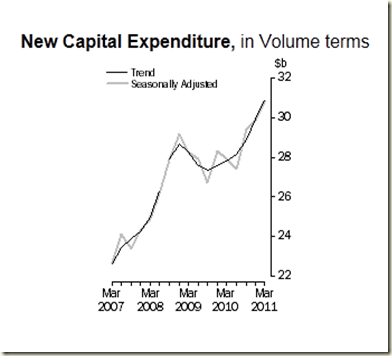
The trend volume estimate for total new capital expenditure rose 3.3% in the March quarter 2011 while the seasonally adjusted estimate rose 3.4%.

The trend volume estimate for buildings and structures rose 2.6% in the March quarter 2011 while the seasonally adjusted estimate rose 4.5%.

The trend volume estimate for equipment, plant and machinery rose 3.8% in the March quarter 2011 while the seasonally adjusted estimate rose 2.4%.

This is not what you would expect to see in an economy about to go belly up due to gross mismanagement.
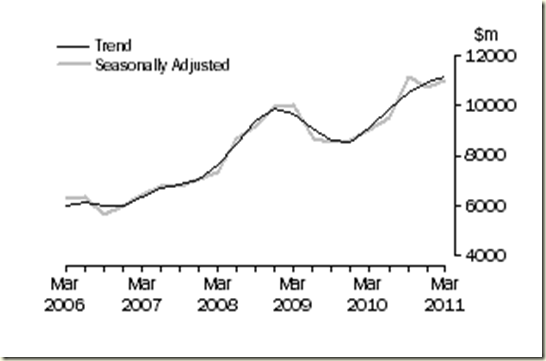
But I know, the mining industry is the really important one – and that’s about to die (though how it survived the end of Work Choices is beyond me). So how is that going? Have a look on the graph on the right. 

Huh. Not too bad it seems.

In fact:

The trend estimate for Mining rose 2.1% in the March quarter 2011. The buildings and structures asset type rose 1.5%, and equipment, plant and machinery rose 2.9%. The seasonally adjusted estimate for Mining rose 2.8% in the March quarter 2011. By asset type, buildings and structures rose 2.6% and equipment, plant and machinery rose 3.7%.

Not too shabby.

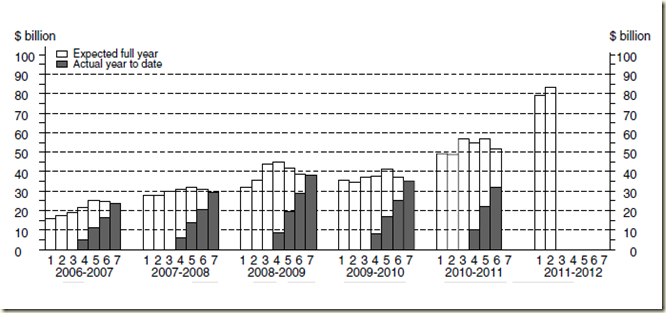
But of course it must be expected to fall into a big heap very soon, given the whole “imminent danger” and all:
image

Hang on, that expected expenditure in the start of 2011-12 looks like a bloody big jump.

Estimate 2 for Mining for 2011-12 is $83,326 million. This is 70.6% higher than the corresponding estimate for 2010-11. Estimate 2 is 5.5% higher than Estimate 1 for 2011-12. Buildings and structures is 2.6% higher and equipment, plant and machinery is 21.7% higher than the corresponding first estimates for 2011-12.

Oh, that’s because it is a bloody big jump.

I guess all those mining companies are just betting that the MRRT and Carbon Price won’t happen…

In Hockey’s MPI speech he also said this interesting little thing which gave away just how trivial is the whole “what did Swan know and when did he know it thing”. In trying to prove that Swan and the Govt expected WA to raise the royalty rate to 7.5 Hockey said this:

Of course, on 2 July 2010 the government announced the deal that they had done with Xstrata, BHP and Rio. In the fact sheet associated with that deal, it says:

  • The MRRT will also provide a full credit for state royalties paid by a taxpayer in respect of a mining project

    It goes on to say:
  • State royalties are assumed to be equal to 7.5 per cent of sales revenue and are credited against the MRRT liability to produce the net MRRT liability.

What does that mean? It means that there was always an assumption by this government that the state governments would remove concessions and it was prepared to rebate up to 7.5 per cent.

What it also means is that if the Government has budgeted for the increase, then the WA Government raising the rate will not actually blow a hole in the Government’s budget.  It is why Hockey hasn’t been mentioning budget holes in relation to this. And what it also means is that this fight is about he said/he said and nothing else. It doesn’t make one difference to the economy or anything happening to real people.

In short, it is Parliament Question Time.image

The other big issue of the day was the Liberal Party nicely unravelling. For some bizarre reason the Opposition Whip, Warren Entsch, decided to send out an email to all Liberal-National Party MP in which he rebuked five Libs for missing a division. One of the five names (right at the top) was Malcolm Turnbull.

That not one person in the Opposition Whip’s office did not think the email would get leaked is rather astounding.

Did they really think putting it in writing was the best way to do it? Whatever happened to the old quiet chat?

Turnbull of course took it all in his stride and spent a good while talking to the media about how he wasn’t going to respond to the email:

"[To] send a letter out like that it's effectively a press release, that's the obvious intent of it. That's what happens when you send letters to half the Parliament."

“Clearly somebody has leaked it, but when you send a letter or email to every member of the government, or the Coalition, the reality is the chances of it finding its way into the hands of the press are extremely high - probably not 100 per cent, but 99 per cent.”

All is not wonderful in the Liberal Party. The tensions can be kept under a lid for only so long – especially when the strategy of getting quickly back into power doesn't seem to be working. As Albanese pointed out today (interestingly it was mentioned in a tweet last week by Possum):

…. as of today, at 1.30, we have passed 112 pieces of legislation through this House—112 supported, zero opposed by this House of Representatives. And we have done that in just eight months. How does that compare with our predecessors? Those opposite would like to say that this parliament cannot function properly because it requires proper negotiation. The fact is that in the first 12 months of the Howard government 108 bills were passed by the House of Representatives, so we have been more efficient and more productive on this side of the House in terms of getting legislation through.

The Government may be down in the polls, but in Parliament it is cruising. Many Libs would be coming to the realisation that they will not go to the polls till near the end of 2013, and that is two budgets away, and a long, long time to put up with Tony Abbott standing for nothing.

Don’t put down your glasses yet. The 2013 race isn’t run.